
12 Difficult Conversation Examples at Work (and the First Line to Say)
Twelve workplace conversations managers dread, the exact first line for each, and a four-step script for when you freeze.
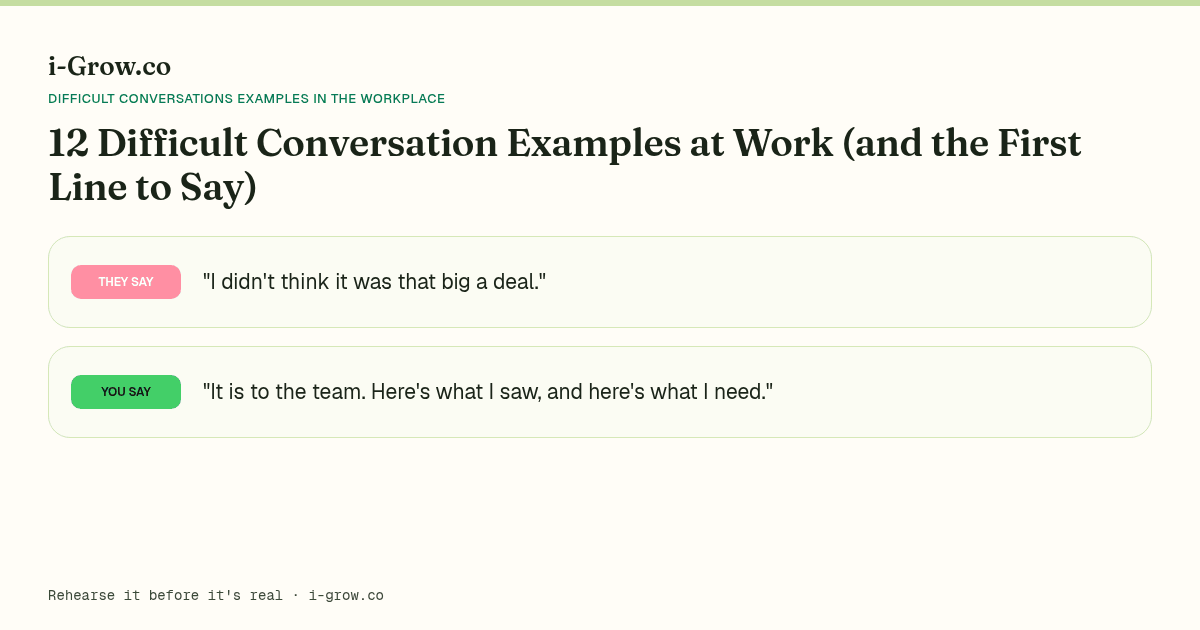
The twelve conversations below are the ones that make new managers freeze — not because they lack the framework, but because they don't know the first sentence. Each one here gets the moment it happens, the exact first line to say, the mistake to avoid, and a page to go deeper before you need it live.
What counts as a difficult conversation at work?
A difficult conversation is any exchange where you expect pushback, where the other person's reaction is genuinely unpredictable, or where the outcome affects someone's job, pay, standing, or sense of fairness. That covers more than firings and PIPs — it includes the performance review with a rating nobody's thrilled about, the passive-aggressive comment you let slide in a meeting, and the moment you have to raise unfairness with your own boss. What makes these hard isn't the topic. It's that you can't script the other person's response, only your own first line.
The 12 difficult conversations every new manager will face
These are the moments that show up on every manager's calendar sooner or later, in roughly the order they tend to arrive.
1. Giving critical performance feedback
This shows up outside the formal review cycle, when a gap needs naming before it becomes a pattern nobody addressed early.
"I need to tell you something hard, and I'd rather say it straight than hint at it."
Mistake to avoid: Don't bury the real point under five minutes of unrelated praise first.
Go deeper: Underperformance feedback playbook.
2. An employee who's always late
A pattern of lateness eventually affects the team's trust in fairness, even when the work itself is fine.
"I've noticed you've come in late [three times] in the last [two weeks] — what's going on?"
Mistake to avoid: Don't let it turn personal or sarcastic — stick to the pattern, not the person.
Go deeper: How to talk to an employee about being late.
3. A first performance review with a rating they won't like
New managers often face this within their first year, and the instinct to soften the number upfront usually backfires.
"This review has some ratings you won't love, so let's start there, not bury it."
Mistake to avoid: Don't open with ten minutes of context before the number — they're waiting for it the whole time.
Go deeper: First performance review as a new manager, and practice it in the performance review simulator.
4. They didn't get the promotion
This conversation usually lands right after a calibration cycle, when someone expected a yes and got a no.
"You didn't get the promotion this cycle, and I want to tell you why and what's next."
Mistake to avoid: Don't let "not yet" sound like "never," and don't over-explain the committee's reasoning on the spot.
Go deeper: What to say when someone doesn't get the promotion.
5. Opening a performance improvement plan
A PIP conversation happens when informal feedback hasn't changed the pattern and the stakes are now formal.
"This is a formal plan, which means your job is genuinely at risk if it doesn't change."
Mistake to avoid: Don't soften the stakes so much that they don't realize it's serious.
Go deeper: PIP conversation playbook, and rehearse it in the PIP conversation simulator.
6. Someone cries during feedback
This can happen in any of the conversations above, often without warning, and most managers have never been told what to do in the moment.
"Take the time you need — I'm not going anywhere, and this still matters."
Mistake to avoid: Don't rush to fix the emotion or end the meeting early just because it's uncomfortable.
Go deeper: What to do when an employee cries during feedback.
7. An employee showing signs of burnout
This surfaces gradually — dropped quality, short answers, missed deadlines from someone who used to be reliable.
"You don't seem like yourself lately, and I want to check in before it gets worse."
Mistake to avoid: Don't diagnose them or play therapist — stay on workload, support, and what's in your control.
Go deeper: How to talk to an employee about burnout.
Practice this skill
Could your managers say line one today?
Most have the framework from a workshop. Fewer have said the actual sentence out loud before it mattered.
Rolling this out to a team of managers? Start a 14-day free trial → or book a 30-minute call with the founders →
8. An employee threatens to quit
This usually arrives as leverage, a genuine warning, or both at once, often in the middle of an unrelated conversation.
"I hear you're considering leaving — tell me what's driving that before we talk solutions."
Mistake to avoid: Don't counter-offer on the spot before you understand the actual reason.
Go deeper: When an employee threatens to quit.
9. Managing a former peer
This starts the day a promotion changes the org chart but not, at first, the friendship.
"Our relationship is changing a little now that I'm your manager, and I want to name that directly."
Mistake to avoid: Don't pretend nothing changed, and don't overcorrect into sudden formality either.
Go deeper: Managing former peers.
10. Letting someone go
This is the conversation every manager hopes to never have and almost all eventually do — a termination or a layoff.
"I have to tell you that today is your last day here."
Mistake to avoid: Don't pad it with small talk or make them guess what's coming before you say it.
Go deeper: What to say when firing someone, or for layoffs specifically, layoffs with dignity.
11. A passive-aggressive comment in a meeting
This happens in real time, in front of other people, and the instinct is usually to let it pass.
"Let's come back to that comment — say more about what you meant."
Mistake to avoid: Don't let it slide and hope it stops — name it briefly in the room, then follow up one-on-one.
Go deeper: practice responses in the passive-aggressive comeback tool.
12. Raising unfairness with your own boss
This is managing up — telling your own manager that a decision or pattern felt unfair to you.
"I want to raise something that felt unfair to me, and I'd like your read on it."
Mistake to avoid: Don't lead with emotion alone — bring the specific decision or pattern you're pointing to.
Go deeper: plan it first with the difficult conversation planner.
Which of these trip up first-time managers most?
The ones with a visible career consequence attached — the review, the PIP, and the promotion denial — tend to cause the most avoidance, because the manager knows the words will be remembered. Managing a former peer belongs in that group too, not because the stakes are formal, but because the manager is improvising a relationship change with no script at all. Those four are worth rehearsing before the others.
What are the four D's of difficult conversations?
There's no single, agreed-upon "four D's" framework — you'll find different versions from different trainers, and treating any one of them as the standard would be misleading. Rather than force-fit a D-word pattern, it's more useful to work from four steps that don't depend on alliteration: Observe what actually happened, name the Impact, Ask their side, then agree on the Next step. It's the same shape underneath most feedback models — just without the naming gimmick.
How do you prepare for a difficult conversation before it happens?
Write down three things before you walk in: what you observed, in specific and neutral terms; the impact it's having, on the work, the team, or trust; and the outcome you actually want, not just the complaint. Vague or accusatory phrasing is easy to miss when you're rehearsing it silently in your head and much harder to miss once you've said it out loud or written it down.
Use the difficult conversation planner to draft the observation, impact, and ask before the conversation — and see how to practice difficult conversations for why rehearsing out loud catches what planning on paper doesn't.
What script do you use when you don't know what to say?
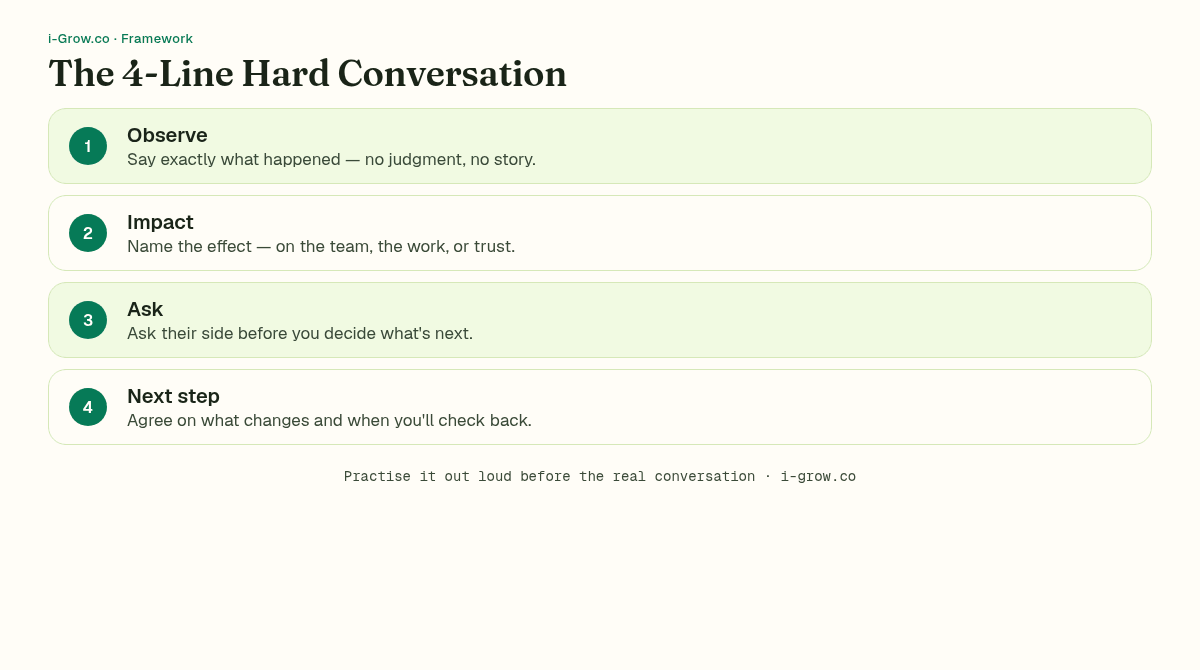
When you freeze mid-conversation, fall back to four lines, in order:
"I want to talk about something specific, not give general feedback."
"Here's what I observed, here's the impact, and here's what I need to see change."
"I want to hear your side before we figure out next steps together."
"Let's agree on what happens next and when we'll check back in."
It won't sound natural the first few times you say it out loud — that's expected, and it's exactly what practice is for. By the third or fourth rehearsal, it stops sounding like a script and starts sounding like you.
What if the conversation goes sideways?
| They say | You say |
|---|---|
| "What if the employee gets defensive right away?" | Don't argue with the defensiveness — restate the observation, not the judgment, and ask what they're seeing that you might be missing. |
| "What if I don't have all 12 memorized?" | You don't need to. Learn the 4-line pattern once and adapt it; the 12 examples are for recognizing the moment, not reciting a script. |
| "What if it's someone who used to be my peer?" | Name the shift directly in the first conversation after the change — avoiding it is what makes the relationship awkward, not acknowledging it. |
| "We already cover this in our workshop." | Good — the workshop teaches the model. This is where managers find out if they can say the first line under pressure, not just on a slide. |
| "What if they go to HR?" | That's a reasonable outcome, not a failure — involve HR early on anything touching policy, pay, or termination. This isn't legal advice; for anything with real legal exposure, loop in HR or employment counsel before the conversation, not after. |
Is avoiding these conversations a sign of poor management?
Often, yes — and it's one of the least visible forms of poor management. It rarely looks like neglect from the outside; it looks like a PIP that keeps getting pushed another quarter, a rating that gets softened until the real message disappears, or a former peer who's allowed to keep treating you like one indefinitely. The twelve conversations above aren't the hard part of the job layered on top of management — for a manager of people, they largely are the job.
How should L&D train these 12 conversations?
A workshop teaches the framework — Observe, Impact, Ask, Next step, or whatever model your program uses. It rarely tests whether a manager can say the actual first line out loud, to a person who's pushing back, before the real moment arrives. That gap is where most of these conversations go wrong: not in the model, in the mouth.
A useful diagnostic for any L&D leader: pick three of the twelve above and ask your managers to say the first line out loud, right now, with no prep. If that's uncomfortable in a safe room, it won't go better live.
Practice this skill
Practice before it's live, not during it.
Start free with three practice conversations, no credit card.
Rolling this out to a team of managers? Start a 14-day free trial → or book a 30-minute call with the founders →
That's the specific gap practice is built to close — AI counterparts that push back at different intensities across scenarios like these. See role-play training for managers, the first-time manager training playbook, and performance review training for managers for how the framework and the practice fit together. Start a 14-day free trial, or book a 30-minute call if you want to talk through fit for your team.
Individual managers can start the same way: start free with three practice conversations, no credit card, and run one of these twelve before you need it for real.
For broader employee-relations practice beyond these twelve scenarios, SHRM's employee relations resources are worth a read.
The conversation doesn't get easier because you waited. It gets easier because you practiced.
Frequently asked questions
What are some examples of problems that can arise at work?
Most come down to twelve recurring moments: critical feedback, chronic lateness, a tough review, a denied promotion, a PIP, tears in a meeting, burnout, a resignation threat, managing a former peer, a termination, a passive-aggressive comment, or raising unfairness with your own boss. Each has a learnable first line and a common mistake to avoid.
What are some examples of poor management in the workplace?
Avoiding a hard conversation is itself a common form of poor management — letting a PIP slide, softening a rating until the message disappears, or staying quiet when a peer-turned-report tests boundaries. The damage isn't the conversation; it's the one that never happens.
How do you confront your boss about unfairness?
Name the specific decision or pattern, not just the feeling: "I want to raise something that felt unfair to me, and I'd like your read on it." State what you observed, why it landed as unfair, and what you'd want instead. Keep it factual, not accusatory, and be ready to hear their side.
What are the four D's of difficult conversations?
There's no single standard "four D's" framework — different trainers use different letters, so citing one as definitive is misleading. A simpler, model-agnostic pattern works for most conversations: Observe what happened, name the Impact, Ask their side, then agree on the Next step.
What's the first line to say when giving critical feedback?
Something direct and specific, not a warm-up: "I need to tell you something hard, and I'd rather say it straight than hint at it." Naming that it's direct feedback — before you give it — lowers the chance it gets lost in a sandwich of praise.
How do you prepare for a difficult conversation before it happens?
Write down exactly what you observed, the impact it's having, and the outcome you want — before you're in the room. A planning tool or a few minutes of out-loud rehearsal catches the vague or accusatory phrasing you wouldn't notice live, under pressure.
Is it okay to use a script in a real conversation?
Yes — a script is a starting line, not a performance. Memorizing the first sentence frees you to actually listen to the response instead of scrambling for an opener. Most managers who "go off script" after line one are doing it right.
How should L&D train managers for these conversations?
Workshops teach the framework; they rarely test whether a manager can say the first line out loud under pressure. Pairing the framework with repeated practice — voice or text, with a counterpart that pushes back — closes the gap between knowing the model and using it live.
Sources
The conversation doesn't get easier because you waited. It gets easier because you practiced.