
They Started Crying Mid-Feedback. Here’s Exactly What to Say Next
What to say in the first ten seconds, a simple rule for pausing or carrying on, the line that gets you back to the point, and the note to send the next day.
When an employee cries during feedback, slow down, say something short and kind (“Take a moment, there’s no rush”), offer tissues or water, and let them choose whether to pause for a few minutes or keep going. Don’t withdraw the feedback or soften it into nothing. When they’re ready, restate the one thing you need in one sentence, agree the next step, and send a short, warm note the next day. If they can’t continue, reschedule within 24 hours and say exactly what you’ll cover.
Most advice stops at “pause and offer tissues.” This guide covers what comes after: how to get back to the point without sounding cold, what to say to “you don’t care” or “I can’t do this right now,” and when to end the meeting and get help.
Why do people cry during feedback, and does it mean you got it wrong?
Tears at work are common, and they’re usually not a verdict on you. In a national survey of more than 700 working Americans that author Anne Kreamer ran with the agency J. Walter Thompson, 41% of women and 9% of men said they had cried at work in the past year. Whether someone had cried made no difference to how much they said they liked their job. Kreamer also reports that workplace tears were more often triggered by anger and frustration than by sadness.
So tears can mean hurt, frustration, embarrassment, exhaustion, or relief that something is finally being said. What they don’t automatically mean is that the feedback was wrong. Afterwards, ask yourself two questions: was it specific and about the work, and was it private? If both answers are yes, the content stands.
Limitation: if the tears come with something bigger, such as grief, a health problem, trouble at home or any mention of harm, stop treating it as a feedback conversation. See when to end the meeting below.
What should you say in the first 10 seconds?
Say little, say it calmly, and don’t try to fix anything yet.
“Take a moment. There’s no rush.”
Then offer tissues or water, and give them a little space: look at your notes for a few seconds rather than staring. On a video call: “I’m going to stay right here. Take whatever time you need. Feel free to turn your camera off for a minute.”
| Don’t say | Say instead |
|---|---|
| “Don’t cry.” (It tells them their reaction is wrong.) | “Take a moment. There’s no rush.” |
| “I didn’t mean it like that.” (It quietly withdraws the message.) | “I can see this has landed hard.” |
| “It’s really not a big deal.” (Then why raise it?) | “It matters, and it’s fixable.” |
| “Calm down.” | Silence, then “No rush.” |
| “Let’s just forget it for now.” (It leaves them guessing all week.) | “Let’s pause and pick this up at 3. Same topic, nothing new.” |
Should you pause the meeting or keep going?
The rule: offer the choice once. If they still can’t talk after a few minutes, reschedule within 24 hours.
“Would you like a few minutes, or would you rather keep going? Either is completely fine.”
If they want a pause: “Let’s take five. I’ll grab us some water and come back.” If they need to stop: “Let’s pick this up tomorrow at 10. It’ll be the same one topic, the Friday reports and what would help. Nothing else is coming.” That last sentence matters. Without it, people spend the evening imagining what else you were going to say.
Never reschedule into vagueness. “Let’s talk later” turns one hard conversation into a week of dread.
Practice this skill
Practice the moment the tears start
Rehearse a feedback conversation with an AI employee who gets upset halfway through. You reply in your own words, then read back what you actually said: did you pause, did you stay kind, did you come back to the point?
Pause, Name, Choose, Return: a four-step restart you can remember
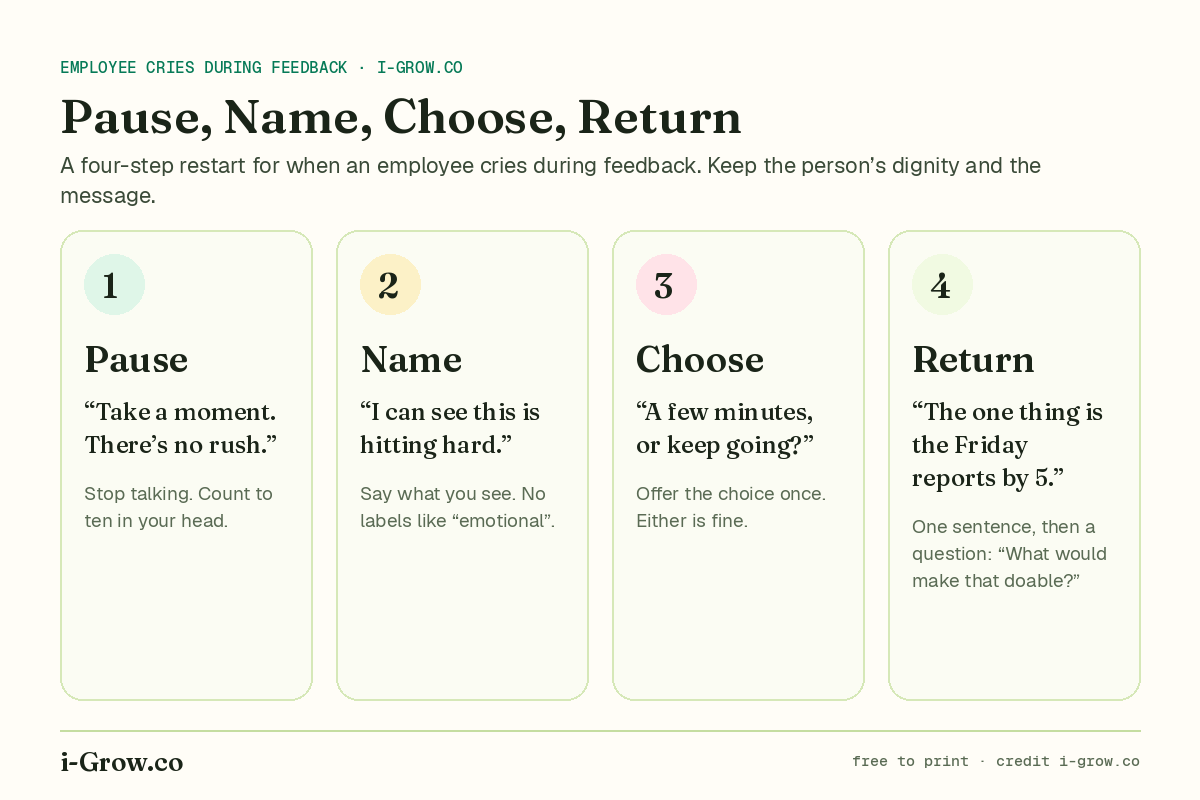
- Pause. Stop talking. Say “Take a moment,” then count to ten in your head.
- Name. Say what you see, without labeling them: “I can see this is hitting hard.” Not “You’re very emotional.”
- Choose. Hand them the control: “A few minutes, or keep going?”
- Return. Restate the one thing in one sentence, then ask a question (the script is below).
Why naming helps: in a brain-imaging study published in Psychological Science, Lieberman and colleagues (2007) found that putting feelings into words (labeling the emotion in an image) reduced the amygdala’s response to negative images compared with other ways of processing them. That’s a lab result about labeling emotion, not a promise that naming theirs will stop the tears. But it supports saying the feeling plainly instead of talking around it.
How do you get back to the message without sounding cold?
Thank them, call it “the one thing”, say it’s fixable, make the ask, and finish with a question:
“Thanks for staying with this. I want to come back to the one thing, because I think it’s fixable: the Friday reports need to reach me by 5. What would make that doable?”
Notice what’s missing: no apology for raising it, no new issues, no “but”. If they ask “Am I in trouble?”, answer honestly. If it’s true, say: “No. This is a normal feedback conversation, not a formal process. I’m raising it because I want this to work.” If it is formal, say so: “This is the first formal step, and HR will walk you through it. I’m telling you directly because I want you to have a fair chance to fix it.” The PIP conversation playbook covers that version.
Take 01 vs take 02
What do you say when they push back through tears?
| They say | You say |
|---|---|
| “You don’t care about me.” | “I do, which is why I’m telling you directly instead of letting it slide. Caring about you and needing this to change are both true.” |
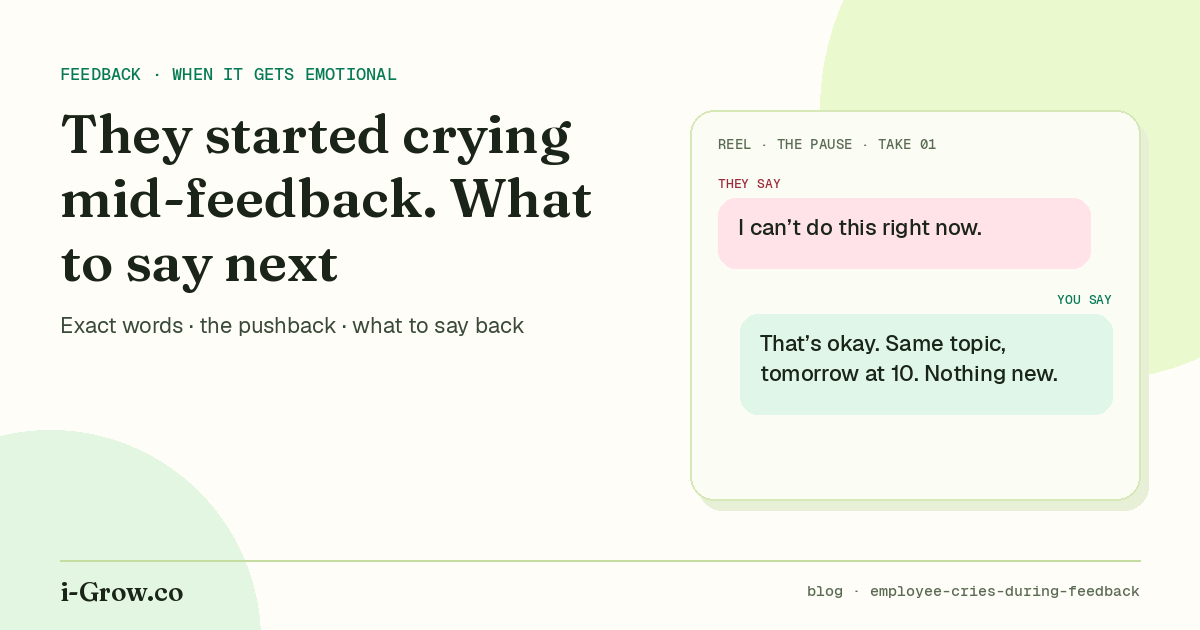
| “I can’t do this right now.” | “That’s okay. Let’s stop here and pick it up at 10 tomorrow. Same one topic, nothing new.” |
| “I’m sorry, this is so embarrassing.” | “You don’t need to apologize. It tells me this matters to you.” |
| “Everyone’s against me.” | “I can only speak for me, and I’m not against you. I’m here because I want this to work.” |
| “I’ve been dealing with a lot at home.” | “Thank you for telling me. Do you want to say more, or would it help to talk about what support there is? The work part can wait.” |
| “Fine. Whatever you want.” (through tears) | “I’d rather have your real view than a quick yes. Take a minute, then tell me what you actually think.” |
| “Is this going in my file?” | “I’ll send you a short note of what we agreed so we both have the same version.” (If it’s part of a formal process, say so and name who in HR is involved.) |
For the reactions that come without tears (“I had no idea”, “that’s not fair”, “I’m overloaded”), use the reply bank in how to tell an employee their work isn’t good enough.
What if you’re the one who freezes?
It’s normal to be thrown. Most new managers’ instinct is to rescue: take it back, change the subject, end early. Before the meeting, write your return line on a card or sticky note, the one sentence you’ll come back to. Slow your voice down when the tears start, and let silence do some of the work. If other people’s strong emotions knock you off balance generally, the free Resilience Lab tracker helps you notice your own patterns over a few weeks.
What should you send the day after?
A short, warm note that restates what you agreed, and nothing else:
“Hi Sam, thanks for yesterday. I know it was a hard conversation, and I appreciated you staying with it. As agreed: Friday reports to me by 5pm, starting this week, and I’ll ask finance for the data by Wednesday. Let’s check in next Tuesday. My door’s open before then.”
Don’t apologize for giving the feedback, don’t add new issues, and don’t mention the tears in writing (“sorry you got upset”). A single, low-key “How are you doing today?” the next morning is enough.
When should you end the meeting and bring in HR?
- The distress doesn’t settle after a pause. Reschedule, and say what you’ll cover.
- They tell you about something bigger: a health condition, a disability, grief, caring pressures, harassment or a safety concern. Put the feedback aside, thank them, and talk to HR about support, flexibility or leave before you go back to performance. If your company has an employee assistance program, offer it.
- Any mention of self-harm. Stay with them and get help now. In the US, the 988 Suicide & Crisis Lifeline is available by call or text at 988, 24/7. Follow your company’s emergency process.
- It happens in every feedback conversation. Don’t stop giving feedback. Talk to HR about what support might help, and keep each conversation short, private and specific.
The same moment in other hard conversations
- In a performance review: offer the same choice, a pause or carry on, then return to the one development focus. See your first performance review as a manager.
- When you’re letting someone go: the decision doesn’t change, but the pause still matters. See what to say when you have to fire someone.
- When it’s a friend who now reports to you: say plainly that it’s a work thing. See managing your former peers.
Rehearse it before it happens
You can’t schedule tears, but you can practise your first ten seconds. On i-Grow.co an AI plays an employee who gets upset mid-feedback. You reply in your own words, then read back what you said: did you pause, name it, offer the choice and come back to the one thing? Plan the conversation first with the difficult conversation planner, and see how to practice difficult conversations for the general method.
Practice this skill
Rehearse this conversation on i-Grow.co
Free to start · Private by default · Practice the pause before you need it.
Frequently asked questions
What should I do when an employee cries during feedback?
Slow down and say “Take a moment, there’s no rush.” Offer tissues or water, then let them choose to pause or keep going. Don’t withdraw the feedback. When they’re ready, restate the one thing you need in a sentence, agree the next step, and send a short note the next day.
Should I stop the meeting if an employee cries?
Offer the choice once: a few minutes’ pause or carry on. If they still can’t talk after a few minutes, stop and reschedule within 24 hours, and say exactly what you’ll cover: “Same one topic, nothing new.” Never leave it as a vague “let’s talk later.”
Should I change my feedback if they get upset?
No. Tears don’t mean the feedback was wrong. If it was specific, about the work and given in private, the message stands. You can change the pace and the setting, and you should listen for new information, but don’t quietly take the point back.
What should I never say to a crying employee?
Avoid “Don’t cry,” “Calm down,” “It’s not a big deal,” and “I didn’t mean it like that.” Each one either judges their reaction or withdraws your message. Say “Take a moment,” “I can see this has landed hard,” and “It matters, and it’s fixable.”
How do I get back to the point after someone gets emotional?
Thank them, name the one thing, say it is fixable, make the ask and end with a question: “Thanks for staying with this. The one thing is the Friday reports by 5. What would make that doable?” Don’t add new issues or apologize for raising it.
Should I follow up after an employee cried in a meeting?
Yes. Send a short, warm note the next day that restates what you agreed and the check-in date, and ask “How are you doing today?” once. Don’t mention the tears in writing, apologize for the feedback, or add anything new.
What if an employee cries every time I give feedback?
Keep giving feedback, but keep each conversation short, private and specific. Talk to HR about what support might help, and if a health, caring or personal issue comes up, put performance aside until you’ve looked at support options.
Can I practise what to say if someone cries?
Yes. On i-Grow.co an AI plays an employee who gets upset halfway through feedback. You reply in your own words and read back what you said: did you pause, name it, offer the choice and return to the one thing?
Sources
- Anne Kreamer, “Go Ahead, Cry at Work”, TIME, April 4, 2011, adapted from It’s Always Personal (Random House, 2011).
- Matthew D. Lieberman et al., “Putting Feelings Into Words: Affect Labeling Disrupts Amygdala Activity in Response to Affective Stimuli”, Psychological Science 18(5), 2007.
- 988 Suicide & Crisis Lifeline (US).
Tears aren’t the end of the conversation. They’re the middle of it.