
Your First Performance Review as a Manager: What to Say, Minute by Minute (and the 8 Replies You’ll Need)
The order, the exact words for each part, and a reply for the eight things people most often say back, plus a one-page sheet to fill in the night before.
To give your first performance review as a manager, send the written review a day ahead, open by saying what the meeting is for, ask for their view of the cycle first, then say the rating in one sentence and back it with two or three specific, dated examples. Answer pushback without changing the rating on the spot, agree one development focus, and close with a date. Send a written summary within 24 hours.
That’s the whole meeting. Knowing the order isn’t the hard part. The hard part is the ten seconds after you say “meets expectations” to someone who expected more. This guide gives you the words for each part, the eight replies you’re most likely to hear, and a one-page sheet to fill in the night before.
Why does a first performance review feel so hard?
It’s the first time someone’s career sits on your sentences, and you may never have seen a review done well. You wouldn’t be the only one. In Gallup’s research, only 14% of employees strongly agree their performance reviews inspire them to improve, and the authors (Robert Sutton and Ben Wigert) write that traditional reviews and feedback “actually make performance worse about one-third of the time.”
Part of the reason, they argue, is surprise: nearly half of employees say they get feedback from their manager a few times a year or less, so the review is the first time they hear it. That’s good news for you, because most of what goes wrong is in your control: no surprises, one clear rating sentence, specific examples, and a plan with a date.
Limitation: a good conversation can’t fix a review process your company designed badly. What it can do is stop your first review from being the reason someone checks out.
What should you do before the meeting?
- Collect two or three pieces of evidence per theme. Each one should be dated and observable: “Two of four launch handoffs went out after the agreed date” rather than “not detail-oriented.” Situation-Behavior-Impact, a feedback model developed by the Center for Creative Leadership, is a good test: when and where it happened, what they did, and what it affected.
- Remove surprises. If anything in the review would be news to them, raise it in a one-to-one this week, not for the first time in the review.
- Send the written review 24 hours ahead if your process allows it, so the meeting becomes a conversation instead of a reading.
- Separate pay from development if you can. Gallup’s authors suggest holding the pay conversation and the performance conversation as two meetings so each gets the right focus. If your company combines them, say at the start which part comes when.
- Fill in the Review Rehearsal Sheet (below) and book 45 to 60 minutes somewhere private, or a camera-on call.
What do you say in the first two minutes?
Say what the meeting is for, and promise the rating won’t be buried. Waiting for the rating is what makes people stop listening.
“Thanks for making the time. You’ve read the written review, so I won’t read it to you. I’d like to spend most of this hour on the parts that matter most to you, and on one area I want us to work on together. I’ll give you the rating early so you’re not waiting for it.”
Should you give the rating first, or let them talk first?
Do both, in that order: ask one open question, then give the rating within the first five minutes.
“Before I say anything else, how would you sum up your last six months?”
Listen properly. Their answer tells you how far apart you are. Then say the rating in one sentence:
“Thanks, that’s helpful, and some of it matches what I’m about to say. I’ve landed on meets expectations. Here’s the short version of why, and then I’ll walk you through the examples.”
Then give the evidence, strengths first and the gap second, with one example each:
“Your client work has been strong. The Henley renewal closed because of your prep. The gap is delivery dates: two of four launch handoffs went out after the agreed date, and design waited three days on the second one. That’s what held the rating at meets.”
Take 01 vs take 02
Practice this skill
Say the rating sentence to someone who expected more
The free first performance review simulator gives you an employee who thinks they’re getting “exceeds”. Pick one, deliver the rating, and see how it lands. No signup, about five minutes. Then rehearse the full conversation in your own words.
What do you say when they push back? Eight replies, word for word
Most guides stop at the opening. Here are the eight replies new managers hear most often, and what to say back.
| They say | You say |
|---|---|
| “That’s not fair. Nobody told me this was a problem.” | “You’re right that you should have heard it sooner, and that part’s on me. I’m telling you now so it doesn’t cost you next cycle.” |
| “Everyone else does the same thing.” | “Maybe. I’m here to talk about your work, and I’d say the same to anyone in your seat.” |
| “So I’m not getting promoted?” | “Not this cycle. Here’s what would need to be true by the next one, and I’ll tell you honestly along the way whether we’re on track.” See how to tell an employee they didn’t get the promotion. |
| “I disagree with the rating.” | “Fair enough. Tell me which example you see differently. If I’ve missed context, I want to know.” |
| (Silence) | “Take a minute. We don’t have to solve anything right now. What’s going through your head?” Then wait. |
| (Tears or visible upset) | “It’s okay. Do you want a few minutes, or would you rather keep going? Either is fine.” See what to say when an employee cries during feedback. |
| “My old manager rated me higher.” | “I can only speak to what I’ve seen in these six months. Let’s make sure the next six give me more to go on.” |
| “What do you actually want me to do differently?” | “One thing: flag date risk at least 48 hours ahead. If I see that by our next check-in, we’re in good shape.” |
The rule under all eight: hear their view once, note any genuinely new context, and don’t change the rating to end the discomfort. If they tell you something you didn’t know, say: “That’s new to me. I’ll look into it and come back to you by Friday. Until then, the rating stands as written.” If your company has a formal way to contest a review, tell them how it works.
If the review is a poor one, the reply bank in how to tell an employee their work isn’t good enough covers “I had no idea”, “I’m overloaded” and “Are you going to fire me?” in more depth.
How do you turn the review into a development plan?
Pick one focus, not three. Three development areas in one sentence sound like a list of everything that’s wrong.
“The one thing that would make the biggest difference next cycle is flagging date risk early. The moment I saw it most clearly was the March launch, when we found out on the day it was due. What would make flagging a risk 48 hours ahead feel normal for you?”
Then ask about them, not the rating: “What do you want to be doing more of a year from now?” Their answer is where the next stretch assignment comes from.
Why it works: one specific behavior with a moment attached is something they can picture doing. “Be more proactive” isn’t.
How do you close a performance review?
“So the summary is: meets expectations, strong client work, and the one focus is flagging date risk 48 hours ahead. You’ll send me draft goals by Friday, I’ll set up the intro to Priya on the platform team, and we’ll check in on the 15th. I’ll put it on the calendar now.”
Then check it landed: “What’s your version of the one thing?” If they can’t say it back, the meeting isn’t finished.
What should you send after the meeting?
A short written summary within 24 hours, so you both have the same version:
“Thanks for today. Summary as discussed. Rating: meets expectations. Strengths: client work and renewals. Focus for next cycle: flag date risk at least 48 hours ahead. Next steps: your draft goals by Friday; my intro to Priya by Wednesday; check-in on the 15th. If anything here doesn’t match your memory of the conversation, tell me and we’ll fix it.”
The Review Rehearsal Sheet: what to write down the night before
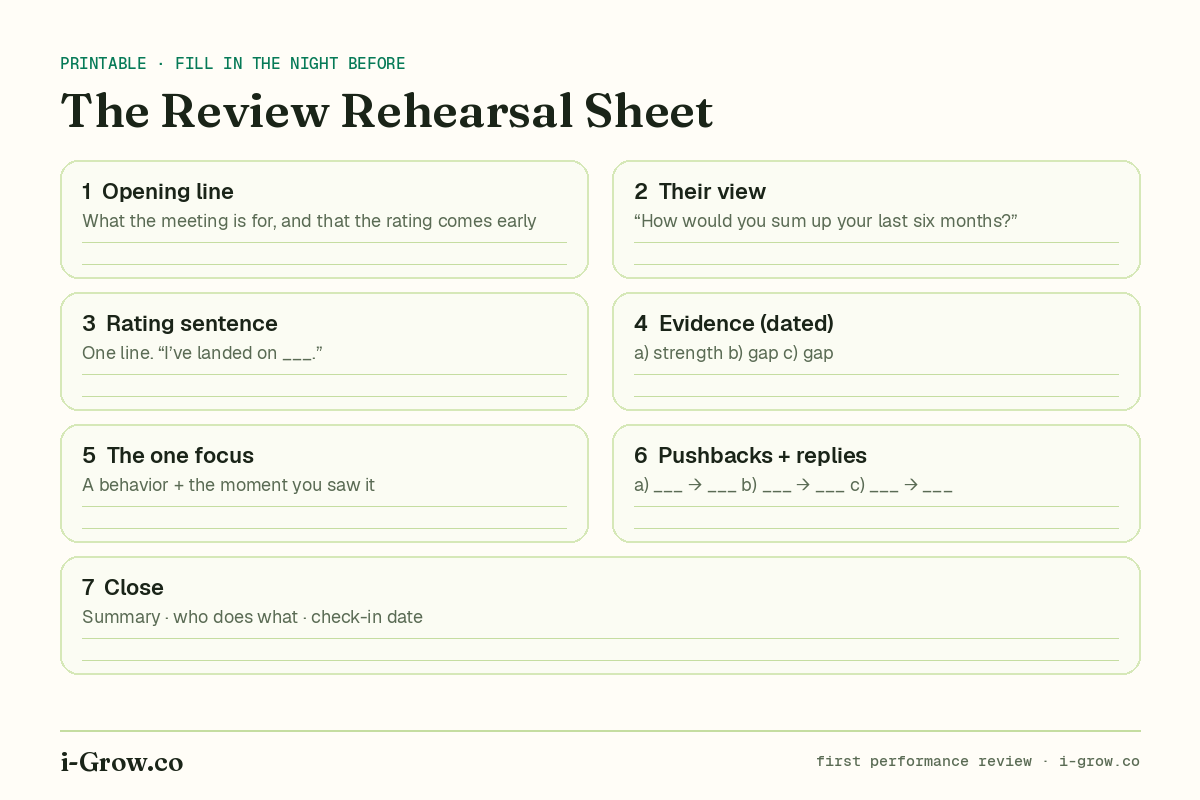
- Opening line: what the meeting is for, and that the rating comes early.
- Their-view question: “How would you sum up your last six months?”
- The rating sentence: one line. If you can’t write it in one line, you’re not ready to say it.
- Evidence: up to three dated examples, at least one of them a strength.
- The one focus: a behavior, plus the moment you saw it most clearly.
- Three pushbacks you expect, and your reply to each (start from the table above).
- The close: the summary, who does what, and the check-in date.
What if you’re reviewing a former peer, or someone with more experience?
A former peer: say plainly that this is your view and you own it. “Because we used to be peers, I want to be extra clear: this is my view as your manager, and I’m not hiding behind the process.” For the wider shift, see managing your former peers.
Someone more experienced: “You’ve known this work longer than I’ve managed it. I’m rating what I’ve seen in six months, and I’d like your help making the next six give me more to go on.”
If it’s heading somewhere formal: when a review is the start of a performance plan, use the PIP conversation playbook and rehearse with the PIP conversation simulator. If it’s already gone further than that, read what to say when you have to fire someone.
Rules of thumb for the moments that go sideways
| Situation | What to do |
|---|---|
| They haven’t read the written review | Give them ten minutes to read it, or move the meeting. Don’t read it aloud to them. |
| They ask you to change the rating | Don’t negotiate in the room. Explain what “next level” looks like and how to get there. |
| They raise context you didn’t know | Note it, check it, and reply by a date. The rating stands until then. |
| They go quiet | Name it once (“You’ve gone quiet”), then wait. Don’t fill the silence with softeners. |
| They cry | Offer a pause or carry on, their choice, then return to the one focus. |
| You realize you got something wrong | Say so, correct it in the written summary, and thank them for raising it. |
Rehearse the hardest two minutes before you walk in
Reading the reply table is the easy part. Saying “I’ve landed on meets expectations” while someone’s face falls is harder. Run that moment first in the first performance review simulator, then rehearse the full conversation on i-Grow.co. An AI plays your direct report and pushes back, you answer in your own words, and you read back exactly what you said before you do it for real. To plan the conversation first, use the difficult conversation planner. For the general method, see how to practice difficult conversations.
Practice this skill
Rehearse your first review on i-Grow.co
Free to start · Private by default · Hear “I disagree with the rating” before the real meeting.
For L&D teams rolling reviews out across new managers, the first-time manager training playbook covers it at team level. More practice drills are in leadership development exercises for new managers.
Frequently asked questions
How do I give my first performance review as a manager?
Send the written review a day ahead, open by saying what the meeting is for, ask how they would sum up the cycle, then say the rating in one sentence with two or three dated examples. Answer pushback without changing the rating, agree one development focus, close with a date, and send a summary within 24 hours.
Should I give the rating first or the feedback first?
Ask one open question first (“How would you sum up your last six months?”), then give the rating within the first five minutes, in one sentence, before the detailed feedback. Making someone wait for the rating means they stop listening to everything you say before it.
How long should a performance review meeting be?
Book 45 to 60 minutes. The rating and evidence take about ten; most of the time should go on their view, the pushback and the development plan. If they haven’t read the written review, give them time to read it or reschedule rather than reading it aloud.
What do I say if my employee disagrees with their review?
Say “Fair enough. Tell me which example you see differently.” Listen, note any genuinely new context, and promise a reply by a date. Don’t change the rating in the room to end the discomfort, and explain how your company’s formal review or appeal process works if there is one.
What performance review phrases should I avoid?
Avoid “This is just HR’s process,” “You always…,” comparisons with coworkers, personality labels like “not detail-oriented,” and three development areas in one sentence. Say instead: “This is my view, and I own it,” plus a dated example of what they did and what it affected.
Can I review someone I used to be peers with?
Yes. Say plainly that it is your view as their manager and you own it, keep to dated examples, and hold them to the same standard as everyone else. If the friendship makes it awkward, name that once at the start rather than letting it shape the rating.
How do I prepare when I’ve only managed them for a few months?
Review only what you have seen, say so, and ask their previous manager for input if your process allows. Use phrases like “I can only speak to these six months,” and focus the development plan on what the next six months should show.
How can I practise a performance review before the meeting?
Fill in the Review Rehearsal Sheet, then say the rating sentence out loud. Try the free first performance review simulator on i-Grow.co, then rehearse the full conversation in your own words with an AI direct report who pushes back.
Sources
- Robert Sutton and Ben Wigert, “More Harm Than Good: The Truth About Performance Reviews”, Gallup, May 6, 2019.
- Center for Creative Leadership, “Use Situation-Behavior-Impact (SBI) to Understand Intent”, updated August 19, 2025. SBI is CCL’s model; we use the name descriptively.
The review is a document. The ten minutes after they read it are the part they’ll remember.