
How to Tell an Employee They Didn’t Get the Promotion: What to Say First, and What They’ll Ask Next
The first sentence, one reason they can use, replies to the eight questions that follow, and a path with dates, including when you weren’t the decision-maker or got the job yourself.
To tell an employee they didn’t get the promotion, meet privately before it’s announced and say the decision in your first sentence: “You weren’t selected for the team lead role this time.” Acknowledge that it’s disappointing, give one specific reason tied to what the role required, and lay out a realistic path with dates. Don’t compare them with the person who got it. Send a short recap the same day, and book a follow-up for a week later, once the news has landed.
Below: the exact opening, what to say to the questions that follow (“What does she have that I don’t?”), what to do when you weren’t the decision-maker, and the recap email.
Why does this conversation matter so much?
Because it’s information about their future, not just a “no.” Researchers JR Keller and Kathryn Dlugos analyzed more than 9,000 internal job rejections at a Fortune 100 company over five years (Academy of Management Journal, 2021). As Cornell’s summary reports, rejected internal applicants were nearly twice as likely to leave as people who were hired or hadn’t applied. Candidates rejected after interviewing with the hiring manager were half as likely to leave as those rejected earlier, and being passed over for another internal candidate rather than an external one also halved the likelihood of leaving.
Keller’s explanation is that employees apply partly to learn what’s likely to be open to them later. So a vague, rushed “no” reads as “there’s nothing for you here.” A specific reason and a believable path read as “not yet.”
Limitation: the study is about signals, not guarantees. You can’t promise the next role, and you shouldn’t. What you can do is be specific about the bar and honest about progress.
Who should tell them, and when?
- You, their direct manager, even if you weren’t the one who decided. Hearing it from HR, a system email or the announcement itself is the worst version.
- Before the announcement, ideally the same day the decision is final. Never let them find out from the org chart.
- Privately, in person or on a camera-on call, not right before they have to present or meet a client.
- Prepared: find out what the panel actually weighed, what you’re allowed to share, and what a realistic next six months could look like.
What do you say first?
“I wanted to tell you myself before it’s announced: you weren’t selected for the team lead role this time. I know you wanted it, and I know you put real work into the process.”
Then stop. Let the silence sit for a few seconds. They need a moment before they can hear anything else.
Take 01 vs take 02
The long warm-up feels kinder, but it makes them wait for the blow and then doubt everything you said before it. If you tend to cushion bad news, run your opening through Hedge Hunter first to spot the softeners.
What reason should you give?
One reason, tied to what the role required, that they can act on:
“The deciding requirement was experience leading a client project end to end. That’s the piece I want to help you build.”
If you weren’t the decision-maker: “I wasn’t the one who decided, but I asked the panel what weighed most. They said end-to-end client leadership. I’d rather tell you that straight than give you a tidy answer.”
Don’t say: “You’ll definitely get it next time,” “It was politics,” or “It was really close” (unless it’s true and you can say what would have tipped it).
Practice this skill
Practice the “why them?” moment
Rehearse with an AI employee who asks exactly what the other candidate had that they didn’t, then asks whether they should start looking elsewhere. You reply in your own words.
What will they ask, and what do you say back?
| They say | You say |
|---|---|
| “What does [name] have that I don’t?” | “I’m not going to compare you two. It wouldn’t be fair to either of you. The deciding requirement was end-to-end client leadership, and that’s what I want to help you build.” |
| “Was this decided before the interviews?” | “Here’s what the panel actually weighed: client leadership and the planning exercise. If you think the process wasn’t fair, tell me what you saw and I’ll take it seriously.” |
| “Should I start looking elsewhere?” | “I want you here, and the path I’m about to describe is real. It’s your call, and I’ll be honest with you along the way about how it’s going.” |
| “I’ve basically been doing the job for months.” | “I know you’ve been covering parts of it, and I’ve seen it. Let’s write down exactly which parts, so it counts next time.” |
| “Can I get feedback from the panel?” | “Yes. I’ll ask the hiring manager for specific feedback and either set up time with them or bring it back to you by Friday.” |
| “So what was the point of applying?” | “You’re now on the panel’s radar, and you know exactly where the bar is. That’s worth something, and I want to make it count.” |
| “Is this because I’m [a parent / older / remote]?” | “That’s a serious concern, and I want it looked at properly, so I’m going to involve HR.” Then do it, the same day. |
| “Okay. Thanks.” (flat) | “This doesn’t need to be settled today. Let’s talk again on Thursday, once it’s had time to land.” |
If they get upset or cry, pause and offer a choice to stop or carry on; the steps are in what to say when an employee cries during feedback. For general defensiveness (“that’s not fair”), the reply bank in how to tell an employee their work isn’t good enough applies here too.
The No, Why, Path, Date structure
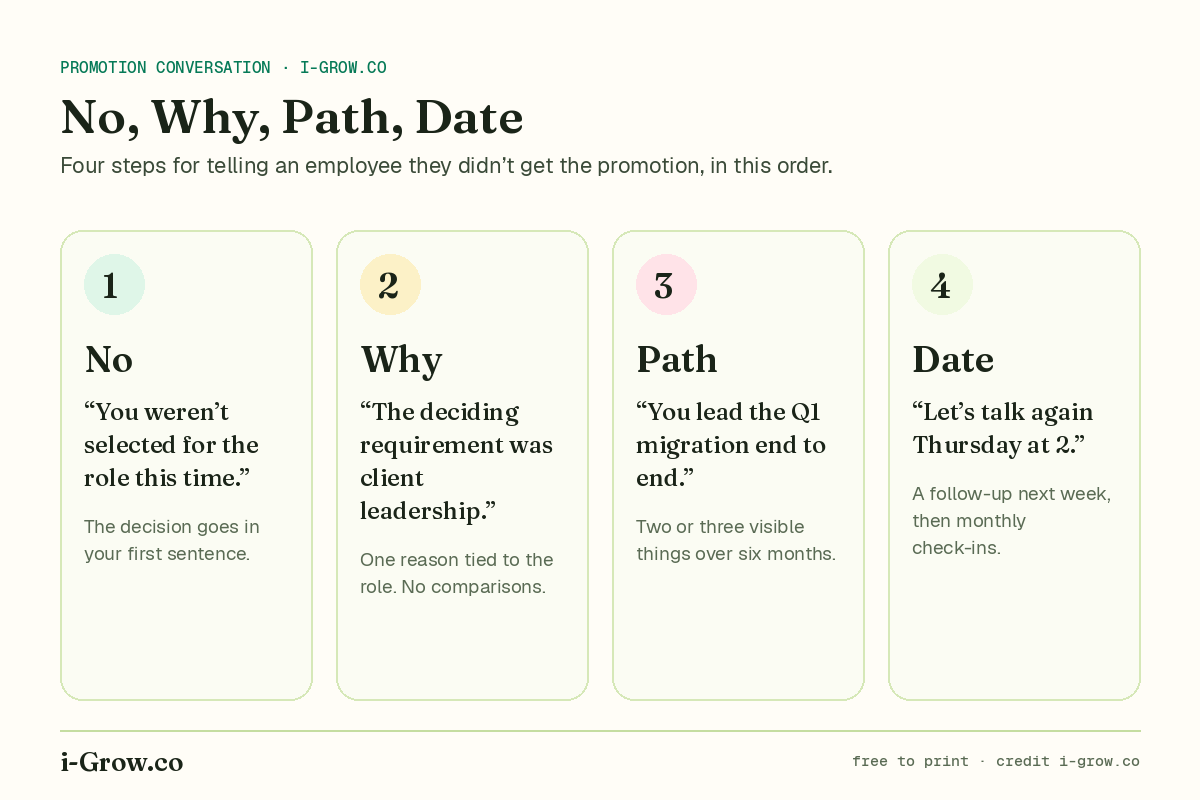
- No: the decision, in your first sentence.
- Why: one reason, tied to what the role required.
- Path: two or three specific, visible things over the next six months, plus what you’ll do.
- Date: a follow-up next week and a regular review point.
Here’s what the path sounds like:
“Here’s what I’d suggest for the next six months. You lead the Q1 client migration end to end, with me as backup rather than owner. I’ll get you into the quarterly planning review. And we check in on the 15th of each month. If we’re on track by June, I’ll tell you. If we’re not, I’ll tell you that too.”
Why it works: the path is made of things they and others can see, and it’s framed as “here’s what we’ll know by June,” not “you’ll get it next time.”
What if you got the job they wanted?
Then it’s two conversations at once, and the awkwardness is part of it. Say it out loud:
“I know this is strange, because I’m the one who got the role. I’m not going to pretend otherwise. I respect your work, and I’d like to help you get where you want to go. What would you like from me?”
Don’t justify the decision or compare yourselves. The full script, including “I’m thinking about leaving,” is in managing your former peers.
What goes in the recap email?
Send it the same day. Keep it short, and make it say the same thing you said in the room.
“Hi Jordan, thanks for talking today. I know it wasn’t the news you wanted. As discussed: the deciding requirement for the team lead role was end-to-end client project leadership. Over the next six months you’ll lead the Q1 client migration, I’ll get you into quarterly planning, and we’ll check progress on the 15th of each month. Let’s talk again Thursday at 2. If I’ve got anything wrong here, tell me.”
What do you say at the follow-up a week later?
“How are you sitting with it now that it’s had a week?”
Then listen. Ask whether the plan still feels right: “Is this the right path, or would you change something?” If they’ve gone quiet in the meantime, name it: “You’ve seemed quieter this week. I’d rather hear it from you than guess.”
Keep the monthly check-ins even when things are busy. A canceled first check-in tells them the path wasn’t real.
Rules of thumb
| Situation | What to do |
|---|---|
| The announcement is tomorrow | Tell them today, in person, before anything goes out. |
| You don’t know why they weren’t picked | Find out before the meeting. “I don’t know” sounds like “nobody cares.” |
| They want a comparison | Decline it every time, then restate the requirement. |
| They raise possible discrimination | Take it seriously and involve HR the same day. |
| Their performance is the real reason | Say so kindly and specifically, then treat it as a feedback conversation. |
| They resign | Thank them, ask what would have changed it, and keep the door open. |
If this comes up in review season, keep the two separate where you can; see your first performance review as a manager for “So I’m not getting promoted?” inside a review. And if a much harder conversation is coming, what to say when you have to fire someone uses the same rule: the decision goes in the first sentence.
Rehearse it before the announcement
The first sentence is short. The hard part is “What does she have that I don’t?” coming at you thirty seconds later. Rehearse it on i-Grow.co: the AI plays the employee who didn’t get the role and asks the questions above, and you read back exactly what you said. Plan your points first with the difficult conversation planner.
Practice this skill
Rehearse this conversation on i-Grow.co
Free to start · Private by default · Practice “why them?” before it’s real.
Frequently asked questions
How do you tell an employee they didn’t get a promotion?
Meet privately before the announcement and put the decision in your first sentence: “You weren’t selected for the role this time.” Acknowledge the disappointment, give one reason tied to the role, lay out a path with dates, send a recap the same day and follow up a week later.
Should I tell them before the announcement?
Yes. Tell them yourself, privately, before anything is announced, ideally the same day the decision is final. Finding out from an email, the org chart or a team announcement is the version people remember and resent.
How much detail should I give about why?
One specific reason tied to what the role required, such as “The deciding requirement was leading a client project end to end.” Enough detail to act on, without reciting the panel’s full discussion or comparing them with the successful candidate.
What do I say if they ask why someone else got it?
Decline the comparison and restate the requirement: “I’m not going to compare you two. It wouldn’t be fair to either of you. The deciding requirement was client leadership, and that’s what I want to help you build.”
What if I wasn’t the one who made the decision?
Tell them yourself anyway. Ask the panel beforehand what weighed most, then say: “I wasn’t the one who decided, but I asked what mattered most. They said client leadership.” Offer to get them direct feedback from the hiring manager.
Should I put it in writing?
Yes, briefly. Send a short recap the same day with the reason, the agreed path, and the next check-in date. It should say exactly what you said in the room, so there is one shared version of the conversation.
What if they say they’ll quit?
Don’t panic or promise the next role. Say: “I want you here, and the path is real. It’s your call, and I’ll be honest with you along the way.” Then follow up a week later and keep every check-in you agreed.
Can I practise this conversation first?
Yes. On i-Grow.co an AI plays the employee who didn’t get the role and asks “What does she have that I don’t?” and “Should I start looking elsewhere?” You reply in your own words and read back what you said.
Sources
- Kathryn Dlugos and JR Keller, “Turned Down and Taking Off? Rejection and Turnover in Internal Talent Markets”, Academy of Management Journal, 2021.
- Julie Greco, “Rejected internal applicants twice as likely to quit”, Cornell Chronicle, August 31, 2021.
“Not this time” only works if you can say what next time looks like.