
Performance Review Training for Managers That Works
A program-level plan for HR and L&D to train managers on performance reviews — and rehearse the conversation itself before review week hits.
Performance review training for managers works when it includes a rehearsed conversation, not just a rubric. Most programs teach managers how to rate fairly and document consistently, then send them into the room with no practice for the moment an employee pushes back. The fix isn't a longer course — it's a short practice rep scheduled between training and review week.
Why Is Review-Season Training a Program Problem, Not a One-Time Workshop?
If training is a single session three weeks before reviews open, you've covered the rubric and missed the moment that actually determines whether the review lands: the ten minutes where a manager has to say something hard to someone's face. Treating that as a program — with a calibration step, a training step, a practice step, and a follow-up step — is what separates a cycle where ratings feel consistent and conversations feel handled from a cycle where HR spends December fielding appeals.
This matters most for teams with a mix of tenured and first-cycle managers, where "we trained everyone" can mean wildly different levels of actual readiness walking into the room. For managers running their first review cycle, start with the fundamentals in first-time manager training before layering on review-specific practice.
Who Actually Needs Training This Cycle — First-Time Managers or Everyone?
Both, but not the same training. First-cycle managers need the full build: how to write a defensible review, how to set the room, how to handle a reaction they didn't expect. Managers who've done this before mostly need two things — a calibration refresh so their ratings land in the same range as everyone else's, and a practice rep for the one conversation on their roster they're already dreading. Skipping that second group because "they've done this before" is how the same three managers end up in HR's office every single cycle.
What Should Performance Review Training Actually Cover?
Expectations and evidence
Managers need to know what "meets expectations" means in concrete, written terms for their own team — not just the company-wide rubric. When expectations stay vague, "this rating came out of nowhere" is the reaction you should expect.
Rating consistency
A calibration session before training, where managers compare draft ratings across teams, catches the manager who rates everyone a 4 and the manager who rates everyone a 2 before either one has the conversation.
The conversation itself
This is the part most programs skip. MIT's HR office frames it directly: the most important part of a performance review is the review conversation, and preparing for it means deciding your key messages, setting the time and space, and being ready to both give and receive feedback — not just deliver a readout. Review materials like last year's review, mid-year check-ins, and the employee's self-assessment before you walk in.
Limitation: none of this is legal advice. If a review feeds into a PIP, a pay change, or a termination, route the documentation language through HR or employment counsel before it's final — a manager improvising wording under pressure is a risk you can train around but not fully eliminate.
How Do You Actually Do a Good Performance Review as a Manager?
Prepare like it's a real conversation, not a form to fill out: decide your two or three key messages in advance, pick a private time and space, and bring the evidence — last cycle's review, mid-year notes, the self-assessment. Open with the headline, not a build-up. Leave room for the employee to respond, and don't treat disagreement as a crisis to shut down — treat it as the part of the conversation you actually prepared for. For a structured run-through before the real thing, managers can rehearse one review themselves with the first performance review simulator.
Is There a Standard "5 Pillars," "Three P's," or "5 C's" Framework for Performance Management?
No — and it's worth saying plainly, because these mnemonics show up everywhere and none of them come from a single standard or governing body. You'll see "5 pillars" framed as planning, monitoring, developing, rating, and rewarding in some training decks. You'll see "three P's" framed as purpose, progress, and people in others. "5 C's" usually describes HR's scope generally (compliance, culture, communication, and so on), not reviews specifically. And "5 words" for a performance review is an informal shorthand, not a framework — something like clear, fair, timely, specific, actionable.
None of these tell a manager what to say when an employee says "nobody told me this was a problem." That's the gap worth spending your training budget on instead of a fourth mnemonic.
Practice this skill
Map your managers' review-season gaps
A 90-day pilot starts with a Learning-Needs Session to find out which review conversations your managers actually dread — before you build the training around guesses.
Rolling this out to a team of managers? See the 90-day pilot (25 seats, $1,500) → or book a 30-minute call with the founders →
What's a Realistic Backward Timeline From Review Week?
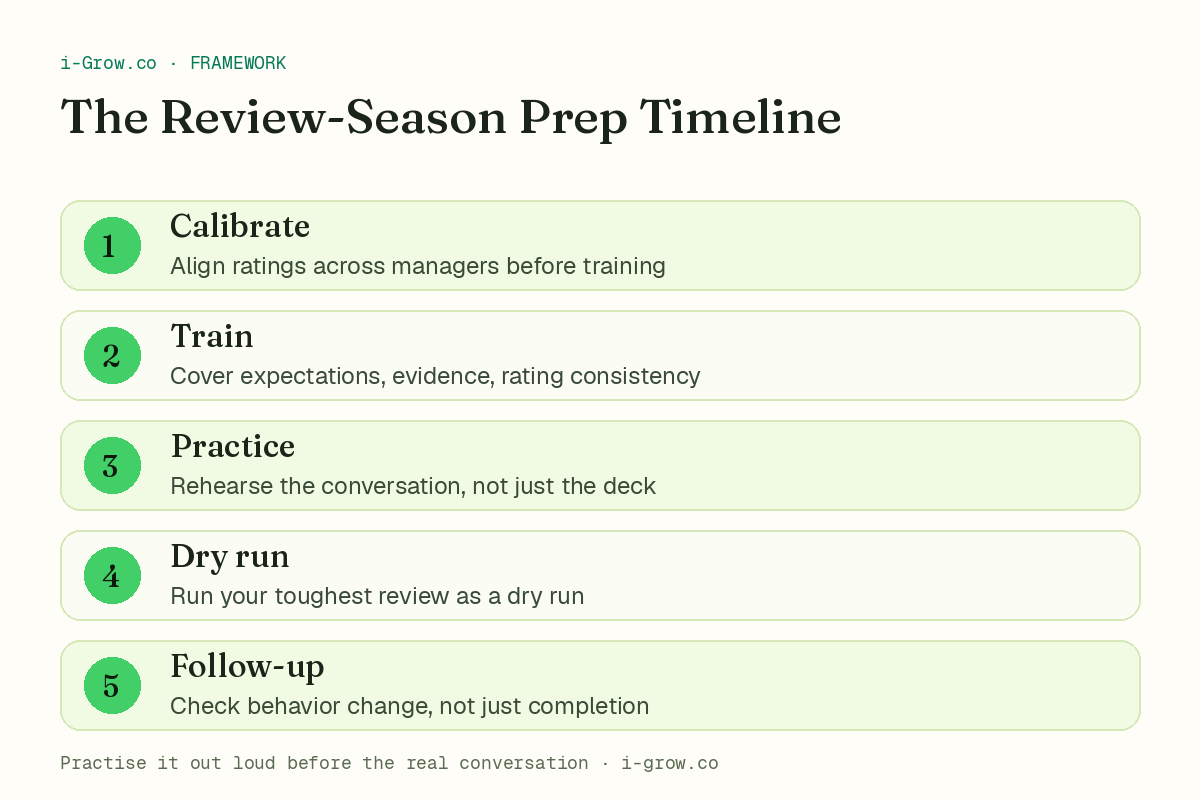
Work backward from the date reviews go out, as a suggested plan rather than a fixed formula — adjust the spacing to your own calendar:
- T-4 weeks — Calibrate: Managers compare draft ratings across teams so the same performance doesn't get rated differently by different people.
- T-3 weeks — Train: Cover expectations, evidence, documentation, and rating consistency in one session.
- T-2 weeks — Practice: Managers rehearse the specific conversation they're dreading — a flat rating, a disagreement, a surprised employee — with a counterpart who pushes back realistically.
- T-1 week — Dry run: Managers run their toughest actual review as a dry run, not a hypothetical one.
- Review week: Reviews happen.
- T+2 weeks — Follow-up: Check whether managers actually changed how they handled the conversation, not just whether they attended training.
Where Does Training Turn Into Silence — and Where Should a Practice Rep Go?
Training that happens three weeks before review week and nothing after it is the gap we're closing. Most programs end at the training session. The manager leaves with a rubric and a deadline, and the first time they actually say the hard sentence out loud is in front of the employee it's about. That's backwards. The practice rep belongs between training and review week — close enough to review week that it's fresh, far enough before it that there's time to adjust.
A single structured run-through, like the difficult conversation planner, forces a manager to write out their opening line and their response to pushback before they're standing in the room reacting to it live. Then the manager says it out loud against someone who pushes back. Writing it is step one; saying it is the rep.
What Do You Say to the Manager Who Dreads This Every Cycle?
Every org has two or three managers who quietly push their hardest reviews to the end of the week, or soften a rating in the room because they can't hold the line face to face. That's not a training gap you fix with more content — it's a rehearsal gap. The fastest way to find out who they are and what specifically they're avoiding is a short Learning-Needs conversation before you build the training, not a generic survey after it.
If the conversation they're avoiding is a pattern of underperformance rather than a single review, that's a different and harder script — see underperformance feedback and, if it's headed toward a formal plan, the PIP conversation.
How Do You Handle the Moment an Employee Disagrees With Their Rating?
This is the moment training usually glosses over and managers remember the longest. Three lines worth rehearsing word for word:
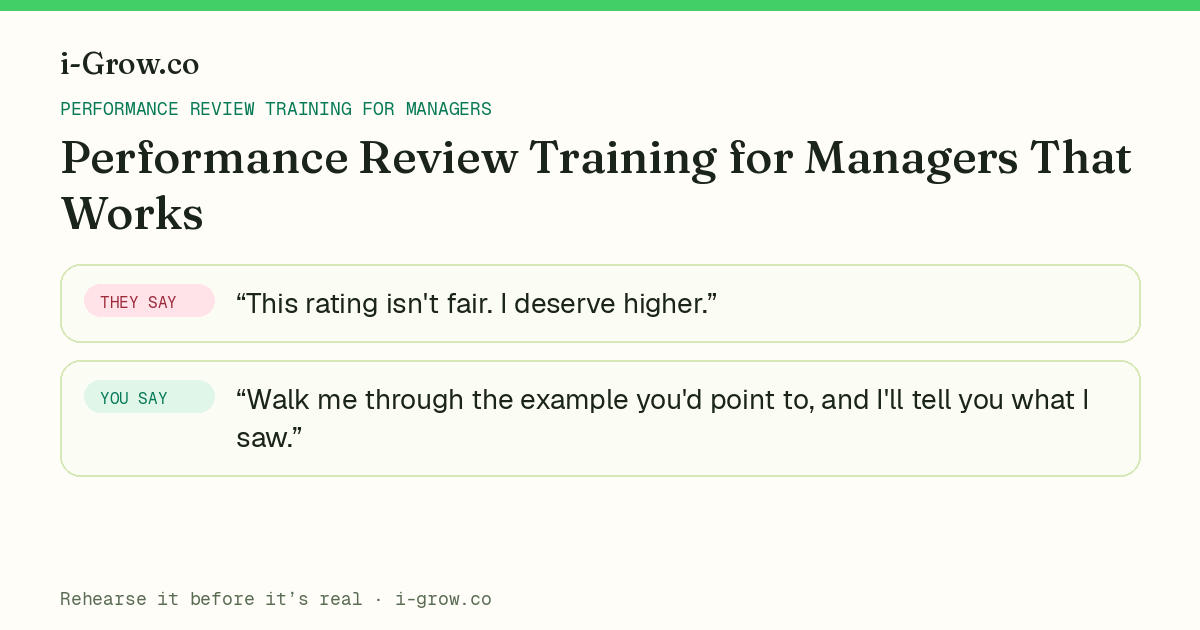
Manager: "I can hear you see it differently. Walk me through the example you'd point to, and I'll tell you what I saw."
This doesn't concede the rating — it opens the conversation instead of shutting it down. If the employee's example doesn't change your view:
Manager: "The rating stands for this cycle. What I can change is what we agree on for the next one, starting today."
And when the real issue is that the feedback feels like it came out of nowhere:
Employee: "Nobody told me this was a problem." Manager: "That's fair feedback for me. You're hearing it now, clearly, and here's what good looks like by March."
None of these lines work the first time a manager says them out loud under pressure. They work the second or third time — which is the entire argument for practicing them before review week, not during it. How to practice difficult conversations walks through why rehearsal changes what people actually say in the moment.
| They say | You say |
|---|---|
| "We already run review training every cycle" | Training on ratings and forms isn't the same as rehearsing the conversation — ask your managers how many actually practiced the specific thing they were dreading before they said it out loud. |
| "Review season is packed, no room for another program" | The practice rep is ten minutes per manager, scheduled inside the existing timeline between training and review week — not a new multi-week course. |
| "Isn't this the same as your review simulator tool?" | No — the tool is one manager rehearsing one review on their own. This is the program layer: calibration, a training schedule, practice reps across the cohort, and a measured outcome. |
| "Our managers will just skip practice" | That's a scheduling and accountability problem, not a reason to skip it — build it into the same calendar invite as training, with a kickoff metric that makes it visible if they don't. |
How Do You Measure Whether Training Changed Anything This Cycle?
Most review-season programs measure reaction and completion: did managers show up, did they like the session. That tells you nothing about whether the next review conversation went any differently. The Kirkpatrick model's four levels of evaluation push past that — reaction, learning, behavior, and results — and behavior is the level that actually matters here: did the manager change what they said and did in the room, not just what they can recite from a slide.
Practically, that means picking a behavior-level metric before training starts, not after — something like "every first-cycle manager completed two practice reps on their hardest review before review week" or "rating appeals that cite a surprise, compared with last cycle" — and checking it again a few weeks after review week, not just in the post-training survey.
Where Does a 90-Day Pilot Fit Into This Cycle?
A 25-seat, 90-day pilot started in early November covers this review season and carries into the next first-quarter cycle, so you're not building a one-off program for a single deadline. It starts with a Learning-Needs Session with Pallavi Bhatt — 20+ years in L&D at Meta, Manulife, and EY — to map which review conversations your managers actually dread, before any training gets built around guesswork. You agree on a success metric in writing at kickoff, get a live kickoff and monthly check-ins, and a direct line to both founders for the full 90 days. It's $1,500 flat, live in under a week, no auto-renewal.
See the 90-day pilot or book a 30-minute call to talk through your actual review calendar. Want to see what the practice itself looks like first? Look at a sample report, or start free, no credit card and rehearse one review conversation yourself.
Practice this skill
Cover this cycle and the next one
Start a 25-seat, 90-day pilot now and it runs through this review season and into Q1. Free to start: 3 practice conversations, no credit card · Private by default.
Rolling this out to a team of managers? See the 90-day pilot (25 seats, $1,500) → or book a 30-minute call with the founders →
Frequently asked questions
How do you do a good performance review as a manager?
Prepare before the meeting: review last year's review, mid-year check-ins, and the employee's self-assessment, and decide your key messages in advance. Set a private time and space. Then treat the meeting as a two-way conversation, not a readout — be ready to give feedback and to hear pushback without re-litigating the rating on the spot.
What are the 5 pillars of performance management?
There's no single standard list. One common framing used in HR training is planning, monitoring, developing, rating, and rewarding. Treat it as a rough map, not a formula — the pillar most programs skip is practicing the conversation that happens inside 'rating' and 'developing,' which is where most reviews actually go sideways.
What are the three P's of performance management?
Like the '5 pillars,' there's no governing body behind this phrase, and different trainers use different versions. A common framing is purpose, progress, and people. Whatever version you use, it's a planning mnemonic, not a substitute for rehearsing the specific conversation a manager is dreading this cycle.
What are the 5 C's of HR?
This is a general HR mnemonic, not a performance-review-specific framework, and it also has no single agreed version. Variants include compliance, communication, culture, compensation, and change. It's useful for describing HR's scope broadly; it doesn't tell a manager what to say when an employee disagrees with a rating.
What are the 5 words performance review?
There's no official 'five word' performance review framework. It sometimes shows up informally as a shorthand for the qualities a good review should have — something like clear, fair, timely, specific, and actionable. Use it as a quick checklist for writing the review, not as a script for delivering it.
How is this different from the free review simulator tool?
The free tool is one manager rehearsing one review conversation. This is the program layer: calibrating ratings across managers, sequencing training before review week, scheduling practice reps, and measuring whether behavior changed afterward. Most HR/L&D teams need both — the tool for individual reps, the plan for the whole cycle.
How fast can a pilot actually launch before review week?
The i-Grow.co pilot is built to go live in under a week: 25 manager seats, 90 days, a Learning-Needs Session to map which conversations your managers dread, and a success metric agreed in writing at kickoff. There's no IT integration required to start.
Is a manager's practice data shared with their boss?
No. Individual practice sessions are private to the manager who's practicing. L&D sees aggregate, team-level skill movement, never individual transcripts, and practice data is never shared with a manager's boss. i-Grow completes security questionnaires before kickoff.
Sources
- MIT HR — Performance Reviews
- Yale — Manager's Guide to Effective Performance Review
- Kirkpatrick Partners — The Kirkpatrick Model
A rubric tells a manager what to think. Practice tells them what to say.