
What to Say When an Employee Threatens to Quit
The words you use in the first 60 seconds after "I'll quit if..." decide whether you keep a good manager-employee relationship or make a promise you can't keep.
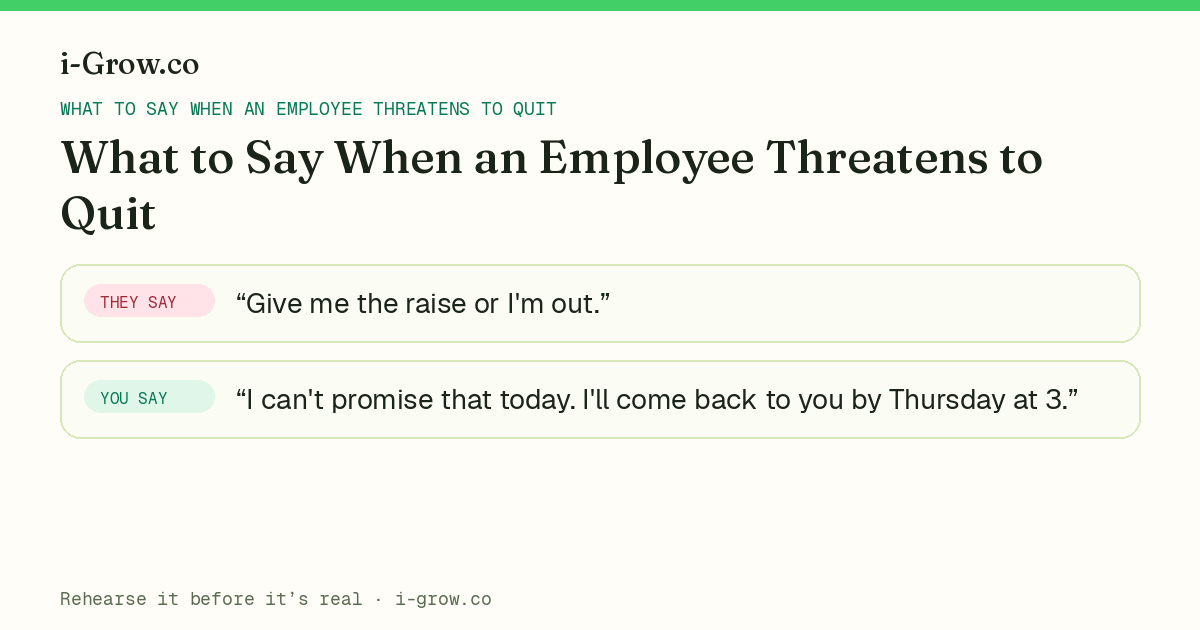
The first thing to say when an employee threatens to quit is nothing you can't actually deliver. Slow the moment down, acknowledge what they said without agreeing to it, and name a specific date you'll come back with a real answer. Don't match their ultimatum with one of your own, and don't promise a raise, a title, or a guarantee on the spot — you'll either overcommit the company or undercut your own case later.
Most managers have never rehearsed this moment before it happens to them for real. That's the gap this post is for: the exact words for the first 60 seconds, and for the conversation that follows depending on whether it's about pay, a promotion, or the third time this has come up.
Why "I'll quit if..." puts you on the back foot
An ultimatum is designed to collapse a complicated decision into a single yes-or-no, answered right now, under pressure. The moment you respond with a yes or a no in that same breath, you've accepted their timeline instead of yours. You might say yes to something you can't actually get approved. Or you say no reflexively and lose someone you didn't need to lose.
The fix isn't a clever comeback. It's refusing to answer on their clock.
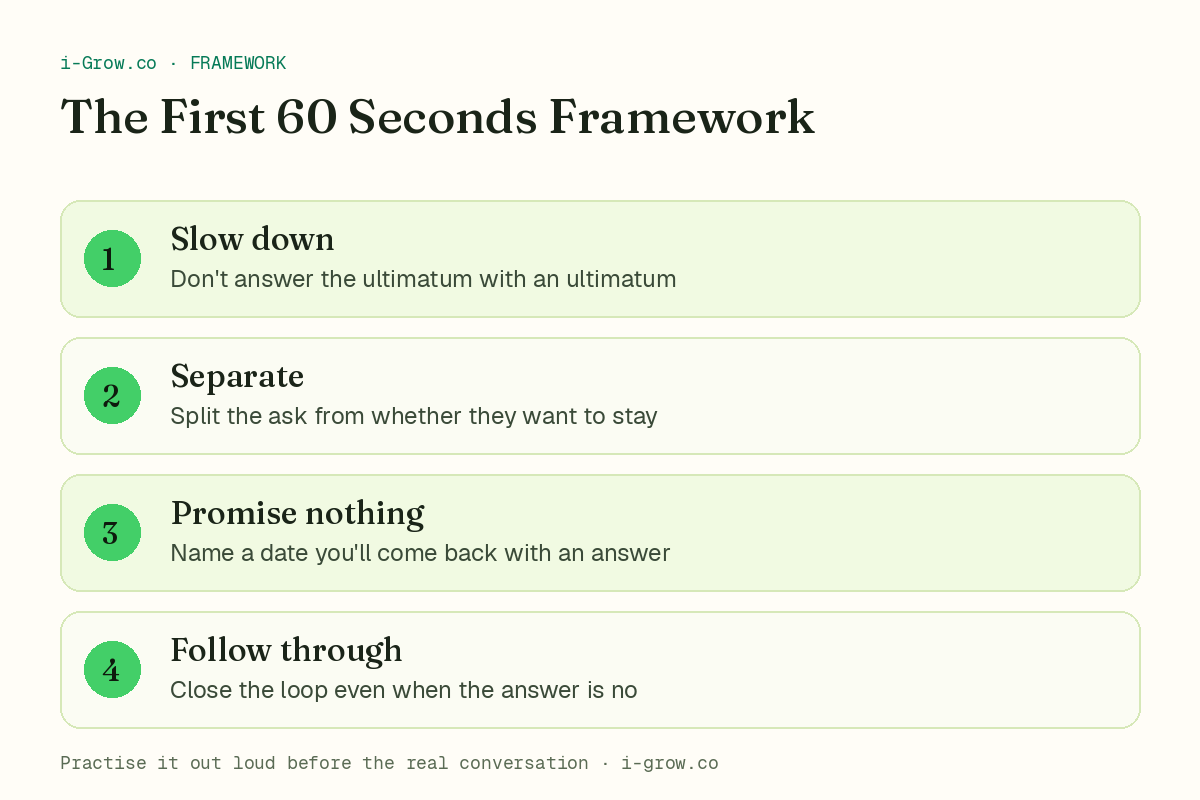
"I hear you, and I don't want to answer that with something I can't actually deliver."
That single line does three things: it tells them you took the threat seriously, it buys you time without sounding dismissive, and it sets the expectation that whatever comes next will be real, not a reflex.
What's the first thing to say when someone threatens to quit?
Once you've bought the time, separate the actual ask from the bigger question underneath it.
"Let's separate two things: the pay question, and whether you want to be here regardless of the answer."
This matters because those are genuinely different conversations. Someone can have a legitimate pay case and still want to stay even if this cycle's answer is no. Or the raise could be a symptom of something else entirely — a bad manager, a stalled project, a team they don't trust. Collapsing both into one ultimatum makes it harder to solve either.
Then set the date. Not "soon," not "I'll look into it" — an actual time.
"I can't promise that today. I'll find out what's possible and come back to you by Thursday at 3."
If it's about a raise
Pay conversations under threat are where managers make their worst promises, because silence feels like losing and a number feels like winning. Resist both.
Go find out what's actually possible — budget, your manager's read, how this compares to others on your team doing similar work — before you say anything more specific than "by Thursday at 3."
If the employee brings up what a coworker makes, don't tell them to stop discussing pay with colleagues. Under U.S. labor law, most private-sector employees have a protected right to talk about their wages with coworkers (see the NLRB's guidance below), and telling them otherwise is both legally risky and a credibility killer if they already know that.
"Everyone else got a raise." "I can talk about your pay and your case, not anyone else's. Let's look at yours."
That keeps the conversation anchored to something you can actually evaluate — their performance, their role, their market data — instead of a rumor you can't confirm or deny.
Practice this skill
Rehearse this before it happens to you
Say your first line out loud against an AI that plays the employee, pushes back, bargains or goes quiet, and get feedback on what you actually said.
Rolling this out to a team of managers? See the 90-day pilot (25 seats, $1,500) → or book a 30-minute call with the founders →
If it's about a promotion
The mechanics are the same, but the stakes feel bigger because a title change usually touches more people than a pay number does — there's a role to fill, a budget line, sometimes a whole structure above or below them. Don't improvise a yes. Don't improvise a no, either, if you genuinely don't know what's possible.
Use the same separation line, adapted:
"Let's separate the promotion question from whether you want to keep building here either way. I'll go find out what's realistic and come back to you by [date]."
If the honest answer later is "not this cycle," say so plainly, and say why, and say what would change it. Vague encouragement ("we'll see, keep doing great work") is worse than a clear no, because it sounds like a promise without being one.
If this is the third time
A one-time ultimatum might be a real, isolated frustration. A pattern is information. If this is the third time an employee has threatened to quit over pay, scope, or respect, treat the pattern as the actual subject of the conversation, not the latest version of the same ask.
"This is the third time this has come up. I'd rather understand what's driving it than keep answering the ultimatum."
That line does something important: it moves you out of the reactive loop of negotiating the same demand over and over, and it puts the conversation on what's actually going wrong: their experience of the role, not just their paycheck. If the real issue is how they're treated day to day rather than what they're paid, that's often a performance-and-feedback conversation in disguise. If an underperformance or feedback gap is part of what's driving it, i-Grow's underperformance feedback playbook is built for exactly that handoff.
When should you stop and bring in HR or employment counsel?
Immediately, if any of these come up: discrimination, harassment, retaliation, unsafe conditions, unpaid wages or overtime, or "my lawyer." Those aren't retention-conversation words anymore — they're legal-exposure words, and the worst thing you can do is keep negotiating like it's still a pay conversation.
This isn't legal advice. In many U.S. workplaces, employment is at-will, which means in theory either side can end it without cause. But if a manager takes action — firing, demoting, cutting hours — right after an employee raises pay, discrimination, safety, or another protected concern, that sequence can look like retaliation, and the EEOC is explicit that punishing someone for asserting these rights is unlawful (see the EEOC's retaliation guidance below). Don't decide how to respond alone, in the room, in the moment. Pause, document what was actually said, and bring in HR or employment counsel before you say anything else.
What should you never promise or threaten in the moment?
Don't promise a number, a title, a timeline, or an exception you haven't actually cleared. Don't threaten a consequence — "well, maybe this isn't the right fit" — that you haven't thought through either. Both are the same mistake in opposite directions: making a commitment under pressure that someone else, later, has to either honor or walk back.
| They say | You say |
|---|---|
| "If I don't answer right away, won't they just quit on the spot?" | Some might. But a specific date shows you're taking it seriously, and an instant answer you can't stand behind costs you more if they stay. |
| "Should I just give them the raise to make this go away?" | Only if you'd approve it on the merits anyway. Giving in to the ultimatum itself teaches them, and anyone watching, that threatening to quit is how raises get decided. |
| "They're bluffing." | Maybe. Either way, your job is to respond to what they said, not to guess their intent — a calm, specific answer works whether they're bluffing or not. |
| "What if they mention discrimination?" | Stop negotiating pay in that instant. Document the exact words used and bring in HR or employment counsel before you respond further. |
The follow-up conversation
Whatever you decided — yes, no, or "not yet, here's what's next" — come back on the date you named, in person or by whatever channel you used to set it, and say the actual decision plainly.
If the answer is no:
"The answer this cycle is no. Here's why, here's what would change it, and here's when we'll look again."
Vague hedging here does more damage than a clear no. If your own message to them tends to come out softer than you intend — more qualifiers, more "maybe," more "I think" — i-Grow's free Hedge Hunter tool strips the hedging out of a draft message before you send it.
What if they quit anyway?
Accept it with dignity. Don't scramble a counter-offer purely to reverse a decision that's already been made — only counter if the case genuinely warrants it on its own.
"I'm sorry to lose you, and I respect the decision. Let's make the handover good for you and the team."
Limitation: none of this guarantees someone stays, and it shouldn't. The goal of this script isn't to talk anyone out of leaving — it's to make sure your side of the conversation is something you can stand behind a month later, whichever way it goes.
Rehearsing this before it happens for real
Reading a script is not the same as saying it out loud under pressure, with someone pushing back, bargaining, or going quiet on you. That's the gap i-Grow.co is built for: you can rehearse a hard conversation like this one — difficult conversation planner is a free starting point — against an AI that plays the employee, defensive or quiet or bargaining, and get feedback on what you actually said, line by line, before the real version catches you off guard. Start free, no credit card.
If this is the kind of conversation that ends the opposite way instead, see what to say when firing someone. For more on building this kind of reflex before you need it, read how to practice difficult conversations and see i-Grow's broader use cases for managers.
For HR and L&D leaders: this is where untrained managers improvise promises
If you're the one reading this on behalf of a team of managers rather than for yourself, notice what's actually hard about this scenario: it's not the words, it's the improvisation under pressure. Every line above only works if a manager can retrieve it in the moment, not just agree with it on a blog post. That's the gap between reading advice and being able to perform it when someone is sitting across from you with an ultimatum.
i-Grow's 90-day team pilot ($1,500 flat for 25 seats) gives 25 managers that rehearsal: a Learning-Needs Session with co-founder Pallavi Bhatt to map where your managers' real conversation gaps are before the cohort even starts, a success metric you agree on in writing at kickoff, and ten-minute reps your managers can run in a browser or on their phone — no IT integration required to get started. Book a 30-minute call with Shantanu or see the 90-day pilot directly.
Practice this skill
Give your managers the reps before the next ultimatum
A 90-day pilot gets 25 managers practicing conversations like this one in under a week. Free to start: 3 practice conversations, no credit card · Private by default.
Rolling this out to a team of managers? See the 90-day pilot (25 seats, $1,500) → or book a 30-minute call with the founders →
Frequently asked questions
Is threatening to quit a fireable offense?
In many U.S. workplaces employment is at-will, so technically yes, in the moment, it can be. But firing someone right after they raised pay, promotion, discrimination, safety, or other protected concerns can look like retaliation, which is illegal in some circumstances. Don't decide this alone in the heat of the moment. Loop in HR or employment counsel first. This isn't legal advice.
What words does HR not want to hear?
Flip the question: as a manager, these are the words that should make you bring HR in immediately, not avoid. Discrimination, harassment, retaliation, unsafe, unpaid or overtime, and "my lawyer" are signals that this conversation is no longer just a retention conversation. Pause, document what was said, and loop HR in before you respond further.
What scares HR the most?
Not the resignation threat itself. It's a manager who, under pressure, promises a raise, a title, or a guarantee the company can't actually stand behind, or threatens a consequence HR never approved. Either one creates a commitment or a liability that someone else has to clean up later.
How do you professionally resign from a toxic workplace?
From the manager's side: if the threat is really about how someone is being treated, ask directly what's making it hard for them and act on whatever part is within your control. If they do resign, accept the decision with dignity, thank them for raising it honestly, and agree on a clean handover rather than trying to talk them out of it on the spot.
Should I just give the employee the raise to make the threat go away?
Only if you'd have approved that raise on its merits anyway. Giving in to the ultimatum itself, rather than the underlying case, tends to invite the same tactic again and signals to anyone watching that threatening to quit is how pay gets decided here.
What if an employee says everyone else got a raise and they didn't?
You generally can't tell them not to discuss pay with coworkers; most private-sector U.S. employees have a right under labor law to talk about wages. What you can do is decline to confirm or deny anyone else's number and keep the conversation on their own performance, their own case, and the actual process for this cycle.
How do I respond when an employee keeps threatening to quit?
Name the pattern out loud rather than re-litigating the ultimatum again: say this has come up more than once and you'd rather understand what's actually driving it. Repeated threats are usually a signal of something unresolved, not a stronger case, and treating each one as a fresh negotiation trains people to keep using it.
What do I do if they quit anyway after I say no?
Accept it without a counter-offer scramble, thank them for the conversation, and focus the remaining time on a handover that protects the team. If you do want to make a counter-offer, do it because the case warrants it, not purely to reverse a resignation that's already been decided.
Sources
The employee who says "I'll quit" is testing what you'll promise under pressure, not what you'll pay.