
How to Talk to an Employee Who’s Always Late: The Exact Words, the 5 Comebacks, and What Happens Next
A four-line opener built on dates, a reply for each of the five things people say back, what to do when the reason is medical or about childcare, and what to say if it keeps happening.
To talk to an employee about being late, meet privately as soon as you see a pattern, name the specific dates, say what the lateness affected, state the start time you need, and ask what’s making it hard. Listen for a real obstacle (a health condition, caring responsibilities, transport), agree a fix and a review date, and follow up in writing. If it continues, tell them plainly what the next step is, before you take it.
Here’s the opener, word for word:
“I want to talk about start times. You arrived after 9:00 on the 3rd, the 7th and the 14th. When that happens, Priya covers the client line on her own for the first part of the morning. I need you on at 9. Is something making mornings hard right now?”
The rest of this guide covers when to raise it, the five comebacks you’ll almost certainly hear and what to say back, what to do if the reason is medical or about childcare, the remote version, and what to say if it keeps happening.
Why does lateness matter enough to raise?
It’s rarely about the minutes. It’s about who covers, and what it tells the rest of the team about the real start time. Research on meetings shows the cost isn’t only in your head. In a set of studies published in 2018, Joseph Allen, Nale Lehmann-Willenbrock and Steven Rogelberg had real groups hold meetings that started on time, 5 minutes late or 10 minutes late. The late meetings scored lower on participants’ satisfaction and perceived effectiveness, and the groups produced fewer, lower-quality and less feasible ideas. An earlier paper led by Rogelberg (2013, European Journal of Work and Organizational Psychology) found meeting lateness to be a frequent workplace event, correlated with job satisfaction and intent to quit.
If you say nothing, you’ve effectively set a new start time, and the people who arrive at 9:00 have noticed.
Limitation: some roles don’t need a fixed start. If nothing actually depends on 9:00, check whether the rule is the problem before you raise it.
When should you bring it up?
Use the second-time rule. The first late arrival gets a light, friendly check (“Everything okay this morning?”). The second or third in a short window gets a private conversation. By the tenth, you’re also explaining why you said nothing for weeks.
Before you talk, take five minutes to:
- Pull the dates from the rota, badge log, standup notes or your calendar. “Always” starts an argument; dates don’t.
- Check you’ve actually said the start time. If it was never stated clearly, that’s part of the conversation.
- Read your attendance policy so you know what the formal next step is, and check whether you’re treating others the same way.
What do you say? The four-line opener
- Dates, not “always”: “You arrived after 9:00 on the 3rd, the 7th and the 14th.”
- The effect: “When that happens, Priya covers the client line on her own.”
- The standard: “I need you on at 9.”
- A real question: “Is something making mornings hard right now?” Then stop talking.
Take 01 vs take 02
This is the same four-sentence structure as the underperformance feedback playbook: what you saw, what it affected, what you need, and their view.
Practice this skill
Practice it with someone who says “It’s only five minutes”
Rehearse the start-time conversation with an AI employee who brushes it off, then gets defensive. You reply in your own words and read back exactly what you said.
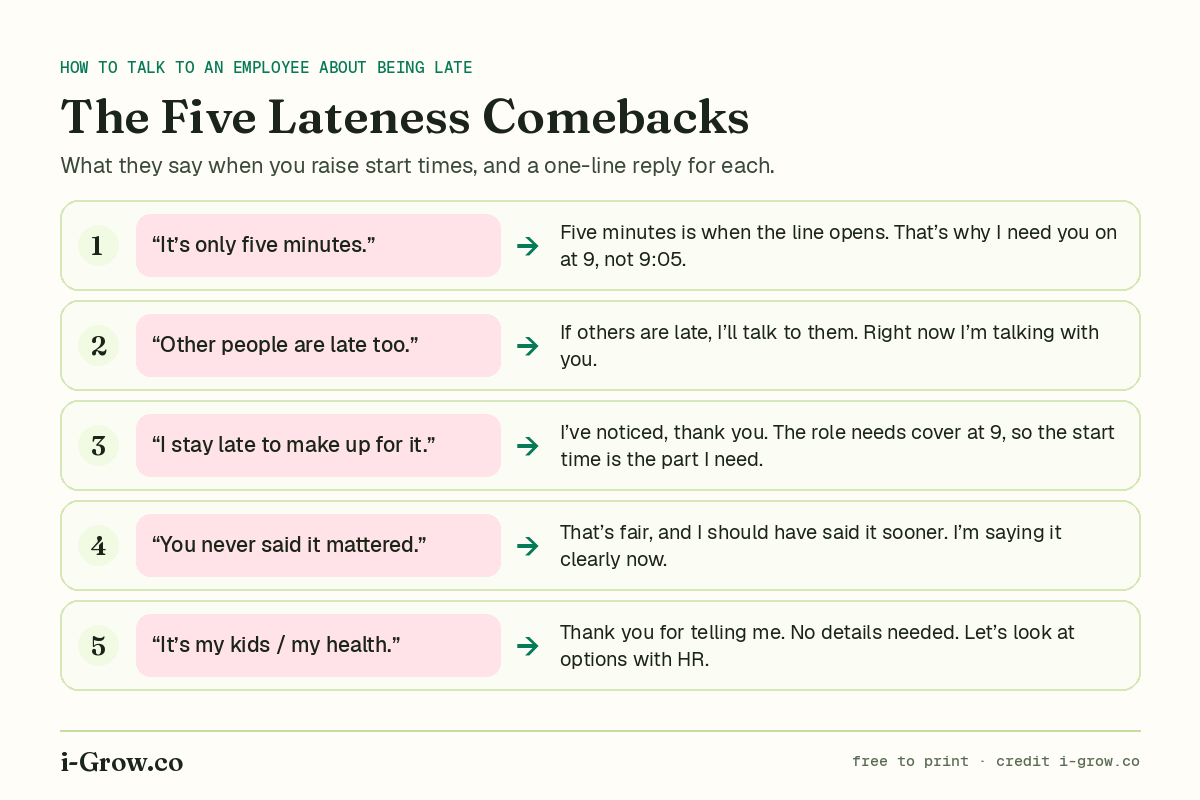
What do you say when they push back? The Five Lateness Comebacks
| They say (and what’s often underneath) | You say |
|---|---|
| “It’s only five minutes.” (They don’t see the effect.) | “Five minutes is when the line opens and Priya is on it alone. That’s why I need you on at 9, not 9:05.” |
| “Other people are late too.” (Fairness.) | “If others are late, I’ll talk to them. Right now I’m talking with you about your start time.” |
| “I stay late to make up for it.” (They think total hours are what count.) | “I appreciate that, and I’ve noticed. The role needs cover at 9, so the start time is the part I need. If the hours could flex, I’d tell you.” |
| “You never said it mattered.” (Often fair.) | “That’s fair, and I should have said it sooner. I’m saying it clearly now: 9:00 start.” |
| “It’s my kids / my health / something personal.” (A real obstacle.) | “Thank you for telling me. You don’t need to give me details. Let’s look at what might help, and I’ll check with HR what options we have.” |
If they push a second time (“So you’re writing me up?”): “No, this is a conversation, not a warning. If it keeps happening, the next step would be a formal warning under our attendance policy, and I’d tell you before that happened.” Only say this if it’s true of your policy.
What if the reason is medical or about caring responsibilities?
Pause the discipline track and bring in HR. Lateness is sometimes connected to a health condition or disability. The Job Accommodation Network (JAN) notes that people with ADHD, OCD, sleep disorders or on certain medications can struggle with punctuality, and lists accommodations an employer might consider, such as a flexible arrival window, a modified schedule, a changed call-in rule or a different shift. JAN also notes that all employees, including employees with disabilities, are responsible for being punctual.
Leave law can apply too. Under the US Family and Medical Leave Act, eligible employees can take leave intermittently when medically necessary, and the Department of Labor’s FMLA fact sheet lists writing an employee up for missing work while using FMLA leave, or assessing negative attendance points for it, as violations. Eligibility rules apply, and state laws may add more. This isn’t legal advice: if health or caring comes up, talk to HR before you go further.
“Thanks for telling me. Let’s pause the attendance side for now. I’m going to ask HR what options we have, like a different start time, and I’ll come back to you by Thursday.”
How do you set the expectation and a review date?
“So we’re agreed: on at 9:00, and if something goes wrong on the way in, message me by 8:45. Let’s look at the next four weeks together and check in on the 28th.”
Then send it in writing the same day:
“Thanks for talking today. As agreed: 9:00 start, and a message to me by 8:45 if you’re running late. We’ll check in on the 28th. Tell me if anything gets in the way before then.”
And when they’re on time for the next two weeks, say so. “I’ve noticed you’ve been on at 9 every day. Thank you, it’s made the mornings easier for Priya.” People repeat what gets noticed.
What if it keeps happening?
Say the next step plainly, before you take it:
“This is our third conversation about start times. The next step under our attendance policy is a formal written warning. I don’t want to get there. What would make 9:00 work from Monday?”
If lateness is part of a wider performance problem, the PIP conversation playbook covers the formal route, and you can rehearse it with the PIP conversation simulator. If it ends in a termination, see what to say when you have to fire someone. Either way, involve HR before the formal step.
What’s the remote or hybrid version?
Late to standup or the weekly call is the same conversation with different evidence:
“You’ve joined standup ten minutes late three times this sprint: Tuesday, Thursday and Monday. The team either waits or repeats the update. I need you there at 9:30. Is it the time that’s the problem, or something else?”
Be open to the answer. If 9:30 is genuinely bad for several people, moving the meeting may fix more than a warning would.
Rules of thumb
| Situation | What to do |
|---|---|
| First late arrival | A friendly check-in, no lecture. |
| Second or third in a few weeks | The four-line opener, privately, with dates. |
| They mention health, disability or caring | Pause the attendance track and talk to HR. |
| They’re a friend or former peer | Name that it’s a work thing. See managing former peers. |
| They get upset or cry | Pause, offer a choice, then return to the start time. See what to say when an employee cries during feedback. |
| It’s improved | Say so out loud, within the week. |
| It’s review season | No surprises: if lateness will be in the review, they should already have heard it from you. See your first performance review as a manager. |
Rehearse it before Monday
The opener is easy to read and harder to say when someone answers “It’s only five minutes” with a shrug. Rehearse it on i-Grow.co: the AI plays the employee, brushes it off and then pushes back, and you read back exactly what you said. Map out your points first with the difficult conversation planner, and see how to practice difficult conversations for the method. For the wider list of new-manager conversations, see challenges new managers face.
Practice this skill
Rehearse this conversation on i-Grow.co
Free to start · Private by default · Hear the five comebacks before the real conversation.
Frequently asked questions
How do I talk to an employee about being late without sounding harsh?
Use dates instead of “always,” say what the lateness affected, state the start time you need and ask a real question: “You arrived after 9:00 on the 3rd, 7th and 14th. Priya covered the line alone. I need you on at 9. What’s making mornings hard?” Calm and specific reads as fair.
When should I address an employee’s lateness?
At the second or third late arrival in a short window. The first can get a friendly check-in. Waiting until the tenth means you’re also explaining why you said nothing, and the team has already noticed the real start time has changed.
Is a verbal warning required for tardiness?
It depends on your company’s attendance policy and local law. Many policies start with an informal conversation, then a documented warning. Read your policy before the conversation, tell the employee plainly what the next formal step would be, and involve HR before you take it.
What if the employee says they’re late because of childcare?
Thank them, don’t ask for details, and look at options: a later start, a flexible arrival window or a different shift, if the role allows. Agree what you can, set a review date, and check with HR before treating it as a discipline issue.
What if they say lateness is caused by a health condition?
Pause the attendance track and talk to HR. Lateness can be linked to a disability or medical condition, and accommodations such as a modified schedule may be appropriate. In the US, FMLA leave may also apply. This isn’t legal advice, so get HR guidance first.
Should HR be in the room for a lateness conversation?
Not usually for the first informal conversation; it should feel like a normal one-to-one. Involve HR before any formal warning, and straight away if the employee mentions health, disability, caring responsibilities or leave.
How do I address lateness for remote employees?
Use the same four lines with remote evidence: “You’ve joined standup ten minutes late three times this sprint. The team waits or repeats the update. I need you there at 9:30.” Then ask if the time is the problem, and be open to moving the meeting.
Can I practise this conversation first?
Yes. On i-Grow.co an AI plays an employee who says “It’s only five minutes,” then gets defensive. You reply in your own words and read back exactly what you said before the real conversation.
Sources
- Joseph A. Allen, Nale Lehmann-Willenbrock and Steven G. Rogelberg, “Let’s Get This Meeting Started: Meeting Lateness and Actual Meeting Outcomes”, Journal of Organizational Behavior, 2018 (doi:10.1002/job.2276).
- Steven G. Rogelberg et al., “Lateness to Meetings: Examination of an Unexplored Temporal Phenomenon”, European Journal of Work and Organizational Psychology, 2013/2014.
- Job Accommodation Network, “Getting to Work on Time”.
- US Department of Labor, Wage and Hour Division, “Fact Sheet #28: The Family and Medical Leave Act”, revised March 2025.
Fix it at late number two, with dates and a real question, and you’ll rarely need to have the conversation about late number ten.