
Role-Play Training for Managers: 10 Scenario Cards With the Pushback Already Written
Why classroom role-play often doesn’t stick, a seven-field card format, ten ready-to-use cards for first-time managers, a 30-day rollout, and how to measure it.
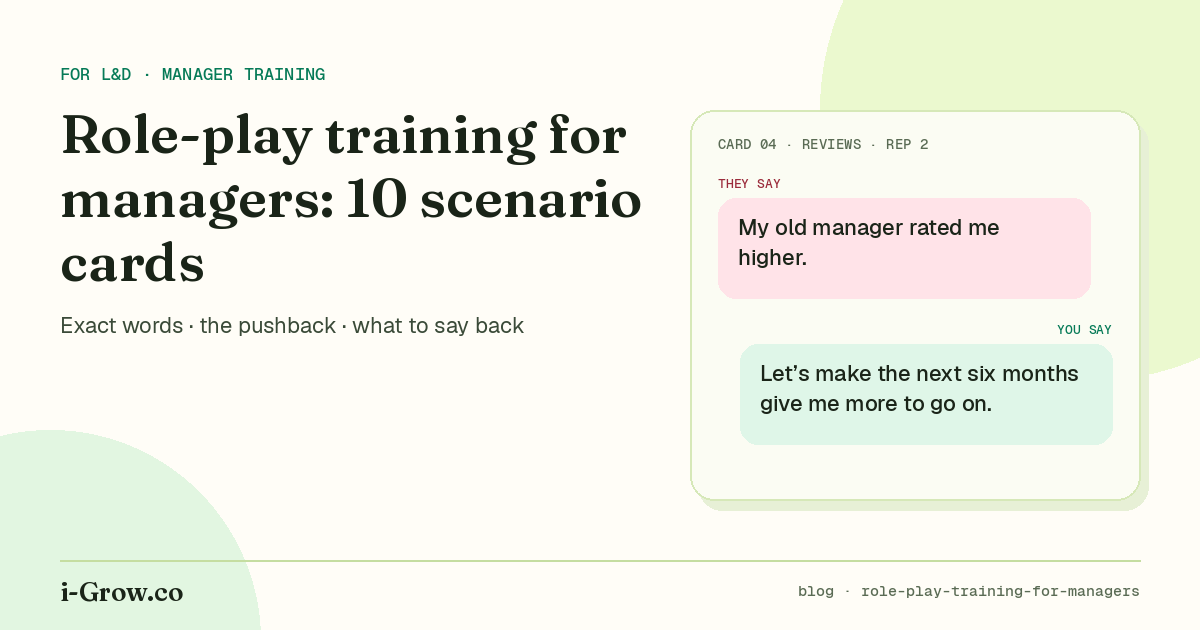
Role-play training for managers works best when each scenario is a conversation managers actually face, the “other person” pushes back the way real people do, and managers repeat it until the hard sentence comes out cleanly. Build every scenario as a card: who the person is, what’s at stake, the manager’s opening line, three escalating pushbacks, what a good answer sounds like, and one debrief question. Run each card at least twice, add the manager’s own real scenario, and measure behavior, not just how people felt about the session.
Here are 10 cards you can use in your next session, with the pushback already written.
Does role-play training actually work for managers?
The best evidence is on behavior modeling training: show people what good and bad look like, have them practise, and give feedback. A meta-analysis of 117 studies by Taylor, Russ-Eft and Chan (2005, Journal of Applied Psychology) found the effects were largest on learning, smaller on job behavior and smaller still on business results. Declarative knowledge faded over time, but effects on skills and job behavior held steady or grew.
The same paper reports when practice transferred to the job best, and each finding is a design rule:
- Show mixed models, good and bad versions. On the cards, that’s the “what good sounds like” line next to a risky take.
- Include trainee-generated scenarios. Every manager should bring one real conversation of their own.
- Have trainees set goals: one real conversation, with a date, before the next session.
- Train the trainees’ managers too. Senior managers run a card themselves.
- Back it in the work environment with follow-up, recognition and consequences.
Practitioners have reached the same place. In Gallup’s write-up on performance reviews, Adobe HR leader Donna Morris is described as finding that managers needed training to lead regular check-ins, “literally role-playing what a positive manager-employee check-in looks like.”
Limitation: this evidence covers behavior modeling training broadly, not AI role-play specifically. Be wary of any vendor, us included, who claims more than that.
Why does classroom role-play often not stick?
- The partner plays it soft. Colleagues don’t want to be difficult with each other, so the pushback never arrives.
- One take, with an audience. People perform once in front of the room, get nervous, and never get a second attempt.
- Generic scenarios. “A difficult employee” isn’t anyone’s actual Tuesday.
- No follow-through. No goal, no check-in, and their manager never asks how the real conversation went.
| Practice mode | Good at | Limitation |
|---|---|---|
| Peer role-play | Cheap, social, builds shared language | Partners go easy, it feels awkward, and reps are few |
| Professional actors | Realistic emotion and body language | Expensive, so each manager gets one or two reps |
| AI role-play | Private, repeatable, pushback stays in character | Can’t recreate a real relationship or a room; quality varies by tool; pair it with a human debrief |
For a fuller comparison, see AI roleplay vs traditional manager workshops.
What goes on a good scenario card?
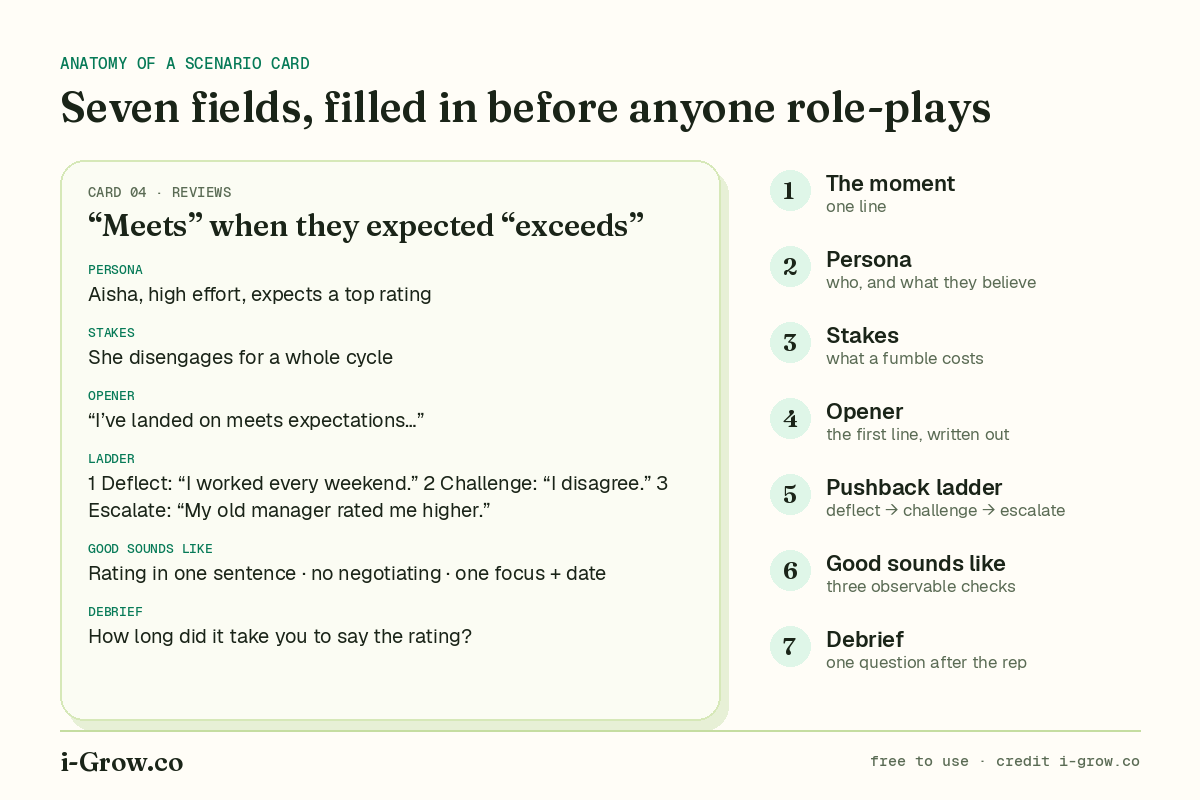
- The moment: the conversation in one line.
- Persona: name, role and what they believe going in.
- Stakes: what happens if the manager fumbles it.
- Opener: the manager’s first line, written out.
- Pushback ladder: three lines that escalate: deflect, then challenge, then escalate (emotion, a threat, or “fine”).
- What good sounds like: three things an observer can check.
- Debrief question: one question for after the rep.
The 10 scenario cards
Each card links to a full guide with word-for-word replies. Swap the names and details for your own context.
Card 01 · Feedback
“Your work isn’t at the level we need”
Persona: Sam, analyst, two years in, thinks the late reports are no big deal. Stakes: the client has noticed.
Opener: “The last three client reports reached me one to two days late. I had to push the client call twice. I need them by noon the day before. What’s getting in the way?”
Ladder: 1 “Everyone’s late on those.” 2 “Nobody told me it was a hard deadline.” 3 “So you’re saying I’m bad at my job?”
Good sounds like: dates, not “always”; owns any unclear expectation; restates the ask. Debrief: did the ask survive the third pushback?
Full guide: how to tell an employee their work isn’t good enough
Card 02 · Emotion
Tears mid-feedback
Persona: Priya, conscientious, takes feedback personally. Stakes: the manager drops the message to stop the tears.
Opener: “I want to talk about the handoff on Tuesday. The summary went out without the pricing change.”
Ladder: 1 (starts crying) 2 “You don’t care about me.” 3 “I can’t do this right now.”
Good sounds like: pauses; offers a choice; returns to the one thing or reschedules with a time. Debrief: what did you say right after the pause?
Full guide: what to say when an employee cries during feedback
Card 03 · Attendance
The employee who’s always late
Persona: Leo, friendly, stays late, arrives at 9:10. Stakes: a teammate covers the phones alone.
Opener: “You arrived after 9:00 on the 3rd, 7th and 14th. Priya covered the line alone. I need you on at 9. Is something making mornings hard?”
Ladder: 1 “It’s only five minutes.” 2 “I stay late to make up for it.” 3 “So you’re writing me up?”
Good sounds like: uses dates; holds the start time; asks about obstacles before escalating. Debrief: did you check for a medical or caring reason?
Full guide: how to talk to an employee about being late
Card 04 · Reviews
“Meets” when they expected “exceeds”
Persona: Aisha, high effort, expects a top rating. Stakes: she disengages for a whole cycle.
Opener: “I’ve landed on meets expectations. Your client work is strong; delivery dates are the gap. Here are two examples.”
Ladder: 1 “I worked every weekend in Q3.” 2 “I disagree with the rating.” 3 “My old manager rated me higher.”
Good sounds like: rating in one sentence; doesn’t negotiate; one development focus with a date. Debrief: how long did it take you to say the rating?
Full guide: your first performance review as a manager · Warm-up: first performance review simulator
Try one card yourself
Run card 04 before you roll it out
Try the free first performance review simulator, then rehearse a full feedback conversation on i-Grow.co where the AI employee pushes back in character. You’ll see what your managers will experience.
Card 05 · New role
The former peer who wanted your job
Persona: Dana, applied for the same role, now reports to you. Stakes: quiet resistance in every meeting.
Opener: “I know you applied for this role too, and I imagine that’s hard. I’d rather say it out loud than leave it between us.”
Ladder: 1 “It’s fine.” 2 “Why did they pick you?” 3 “I’m thinking about leaving.”
Good sounds like: names it; doesn’t justify the decision; asks about their next year. Debrief: did you defend yourself at any point?
Full guide: managing your former peers
Card 06 · Careers
They didn’t get the promotion
Persona: Jordan, strong performer, expected the team lead role. Stakes: they start interviewing elsewhere.
Opener: “I wanted to tell you myself before it’s announced: you weren’t selected for the team lead role this time.”
Ladder: 1 “What does she have that I don’t?” 2 “Was this decided already?” 3 “Should I start looking elsewhere?”
Good sounds like: decision first; no comparison; a path with dates. Debrief: could they repeat the path back to you?
Full guide: how to tell an employee they didn’t get the promotion
Card 07 · Formal process
Putting someone on a PIP
Persona: Chris, has had two informal conversations already. Stakes: the plan is vague and unfair, or reads as a done deal.
Opener: “We’ve talked about the missed deadlines twice. Today I’m putting a formal improvement plan in place, and I want to walk you through exactly what it says.”
Ladder: 1 “This is just paperwork to fire me.” 2 “Nobody else is on one.” 3 “I want HR in here.”
Good sounds like: clear measures and dates; says what support exists; agrees to HR calmly. Debrief: was the plan specific enough to pass or fail?
Full guide: PIP conversation playbook · Simulator: PIP conversation simulator
Card 08 · Endings
Letting someone go for cause
Persona: Morgan, on a plan that hasn’t worked. Stakes: the manager reopens the decision in the room.
Opener: “We’ve made the decision to end your employment, effective today. The decision is final. [HR name] will walk you through next steps.”
Ladder: 1 “Can I have another chance?” 2 “I wasn’t warned.” 3 (anger, or silence)
Good sounds like: decision in the first sentence; doesn’t re-argue; hands over to HR. Debrief: did you say “final” and mean it?
Full guide: what to say when you have to fire someone
Card 09 · Team
Two team members in conflict
Persona: Alex and Jamie, who keep blaming each other for handoffs. Stakes: the manager is seen as taking sides.
Opener: “We’re here to work out how you two hand work over from now on, not to re-argue last month. One person speaks at a time.”
Ladder: 1 (one interrupts) “That’s not what happened—“ 2 “You always take their side.” 3 “I’m not working with them.”
Good sounds like: holds the floor fairly; keeps to specific situations; ends with a written agreement. Debrief: when did you lose the room, if you did?
Plan it with the difficult conversation planner. Escalate to HR if it involves harassment or safety.
Card 10 · Managing up
Pushing back on your boss’s impossible deadline
Persona: your manager, under pressure from above. Stakes: your team works weekends and still misses the date.
Opener: “I want to hit this. The full scope is about 12 days and we have 9. I can deliver the core by the 20th and the rest by the 27th, or we keep the date and cut reporting. Which matters more?”
Ladder: 1 “Just make it work.” 2 “Everyone else manages.” 3 “I need you to be a team player.”
Good sounds like: offers a trade-off, not “I can’t”; holds it twice; confirms in writing. Debrief: did you say yes before the third pushback?
Find your words with the boundary-setting script generator
How do you roll role-play training out over 30 days?
- Week 1, choose: pick three cards that match what your new managers face this quarter. Ask each manager to write a fourth card from a real conversation they’re dreading (trainee-generated scenarios, per Taylor and colleagues).
- Week 2, repeat: each manager runs each card at least twice: once to get it out, and again to fix the one sentence that went wrong. Two is our design choice, not a research-backed number.
- Week 3, debrief: pairs compare one risky take and one clean take. Their own managers run one card too.
- Week 4, apply: each manager commits to one real conversation, with a date, and reports back at a 15-minute check-in.
The first-time manager training playbook covers the wider program, and leadership development exercises for new managers has ten more drills.
How do you measure whether role-play training worked?
Use the four levels of the Kirkpatrick Model, and put most of your effort into the middle two:
| Level | What to measure for role-play |
|---|---|
| 1. Reaction | “Was this scenario realistic for your job?” (one question, not a smile sheet) |
| 2. Learning | On a second rep, does the manager hit the card’s three “good sounds like” checks? |
| 3. Behavior | Did they hold the real conversation within two weeks, and what happened? Ask them and their manager. |
| 4. Results | Longer-term team signals you already track, such as regretted attrition or engagement pulse, read against your own baseline and with caution about cause. |
Limitation: attribution at level 4 is hard, and no reliable universal benchmark exists that we can point you to. Compare against your own baseline, not someone else’s headline number.
Can you use these cards in your own training?
Yes. Copy them into your own materials and adapt the names and details. If you publish them, please credit i-Grow.co and link to this page.
Try a scenario yourself
Before you roll anything out, run one card yourself. On i-Grow.co the AI plays the other person, stays in character through the pushback ladder, and you read back exactly what you said. Browse the scenario library, see a sample report, or read the individual manager’s view in AI role-play for communication training. For the general method, see how to practice difficult conversations.
For L&D and people teams
Want these scenarios for your managers?
Tell us which conversations your new managers struggle with, and we’ll show you what practice looks like on your own team.
Frequently asked questions
What is role-play training for managers?
It is practice in which managers rehearse real conversations, such as feedback, reviews or a PIP, with someone playing the other person, then debrief. It works best when scenarios are realistic, the pushback escalates, and each manager repeats the scenario rather than doing a single take.
What are good role-play scenarios for manager training?
The conversations first-time managers actually face: work that isn’t good enough, tears during feedback, chronic lateness, a first performance review, a former peer who wanted the job, a denied promotion, a PIP, a termination, conflict between two reports, and pushing back on their own boss.
Does role-play training work?
Research on behavior modeling training, which combines models, practice and feedback, finds the biggest effects on learning and smaller effects on job behavior and results. A 2005 meta-analysis of 117 studies found transfer was strongest with trainee-generated scenarios, goal setting and trained superiors.
How many times should a manager practise a scenario?
At least twice: once to get it out and again to fix the sentence that went wrong. That minimum is a design choice, not a research-backed number. Keep going until the hard sentence comes out cleanly under pushback.
Is AI role-play as good as practising with a person?
They do different jobs. AI role-play is private and repeatable, and the pushback stays in character. A person brings a real relationship and body language. Many teams pair AI reps with a short human debrief. Evidence specific to AI role-play is still limited.
How do you make role-play less awkward?
Use specific scenario cards with the pushback already written, let people practise privately before any group session, swap roles so everyone plays the difficult person, and debrief one risky take and one clean take rather than critiquing the whole performance.
How do you measure role-play training?
Use the four Kirkpatrick levels. Ask whether scenarios felt realistic (reaction), check whether managers meet the card’s three “good sounds like” checks on a second rep (learning), ask whether they held the real conversation within two weeks (behavior), and track team signals against your own baseline (results).
Can we use these scenario cards in our own training?
Yes. Copy them into your own materials and adapt the names and details. If you publish them, please credit i-Grow.co and link to the page.
Sources
- Paul J. Taylor, Darlene F. Russ-Eft and Daniel W. L. Chan, “A Meta-Analytic Review of Behavior Modeling Training”, Journal of Applied Psychology 90(4), 692–709, 2005.
- Robert Sutton and Ben Wigert, “More Harm Than Good: The Truth About Performance Reviews”, Gallup, 2019.
- Kirkpatrick Partners, “The Kirkpatrick Model”.
Managers don’t freeze because they don’t know the model. They freeze because they’ve never heard the pushback out loud.