
How to Talk to an Employee About Burnout: A Check-In Script
A check-in script for managers: what to say first, how to answer the pushback, what to change this week, and when to hand off to EAP or HR.
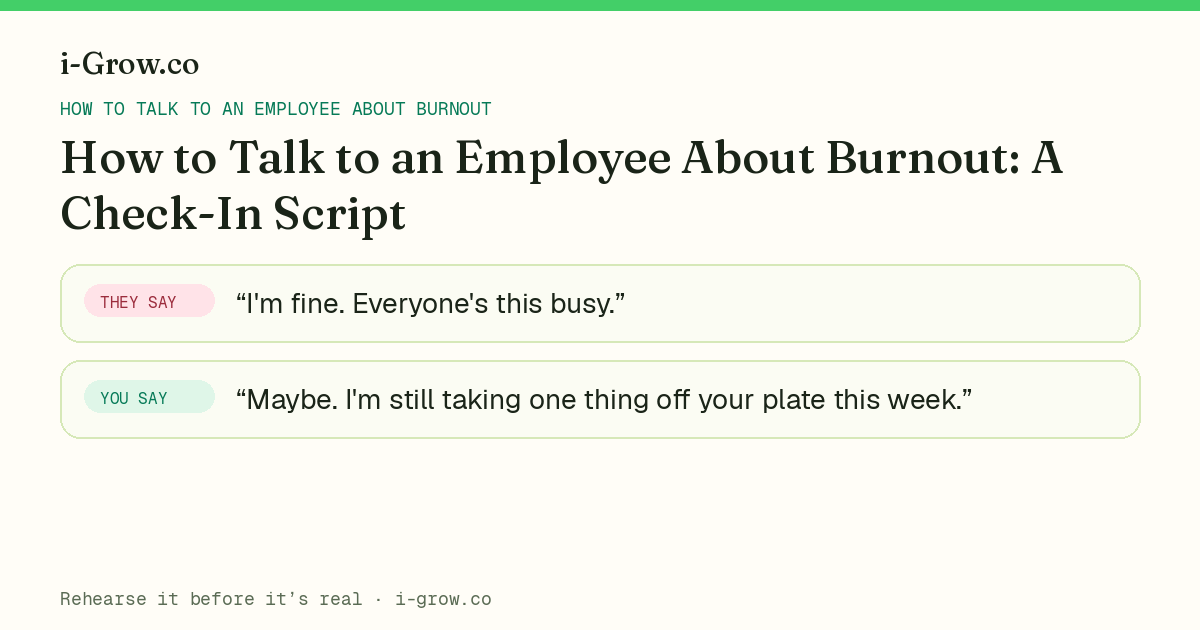
To talk to an employee about burnout, book a private 20-minute check-in, name what you've noticed at work ("you've been online past 9 most nights, and Friday's handoff slipped twice"), and ask one open question: "How are you doing with the load?" Then listen. Offer one or two concrete changes to their work this week, set a date to check back, and point them to your Employee Assistance Program (EAP). You're there to adjust the work, not to diagnose anything.
Most guides on this topic are policy PDFs and lists of warning signs. They tell you to "have a supportive conversation" and stop there. This one gives you the exact words: the opener, the replies when they say "I'm fine" or "everyone's this busy," what to change, and when to hand off.
What are the signs of burnout you can actually name?
Name behaviour you've seen at work, not a label. The World Health Organization describes burnout as an occupational phenomenon linked to chronic workplace stress that hasn't been managed, and it is explicitly not classed as a medical condition. That's useful for you as a manager. It puts the conversation on the work, which is the part you can change.
Signs worth a check-in:
- Hours up, output flat. Late-night messages, weekend commits, but the work isn't moving faster.
- Reliable things slipping. Someone who always hit deadlines misses two in a row.
- A change in tone. More cynical in meetings, shorter in Slack, irritable about small things.
- Pulling back. Camera off, quieter in team channels, skipping the optional stuff they used to enjoy.
Write down two or three facts with dates before you talk. "You've been online past 9 on most nights for three weeks" is a fact. "You seem burned out" is a label, and it invites "No, I'm not."
Limitation: none of these signs proves anything. People have bad months for many reasons. That's exactly why you ask instead of tell.
What do you say first?
Keep it private, keep it short, and lead with care plus one fact.
"I wanted to check in, and it's not about performance. Over the last three weeks I've noticed you've been online past 9 most nights, and Friday's handoff slipped twice, which isn't like you. How are you doing with the load?"
Then stop talking. Silence feels long to you. To them it's room to answer. If they go quiet, give them an easier way in:
"You don't need a polished answer. What's feeling heaviest right now?"
Don't open with "Is everything okay at home?" or "Are you burned out?" The first pries into their personal life. The second asks them to accept a label before they trust you.
What should you ask next, without playing therapist?
Ask about the work, recovery time and support. Three questions are enough:
"What's taking the most out of you right now?"
"When did you last have a real evening or weekend off?"
"If you could drop or move one thing this week, what would it be?"
Listen for things you can change: too many projects, an unclear priority, a deadline someone set without asking, a teammate's gap they've been quietly covering. Those are yours to fix.
If they start talking about sleep, health or something at home, don't dig. Say "Thank you for telling me. I'm not the right person to advise on that, but I want you to have support," and mention the EAP. More on that below.
Practice this skill
Rehearse the "I'm fine" moment
Practise the check-in with an AI employee who brushes you off, then hears you out. Say it in your own words and see what you actually said.
Rolling this out to a team of new managers? Book a 30-minute pilot fit call →
Notice, Ask, Adjust, Return: the four-step check-in
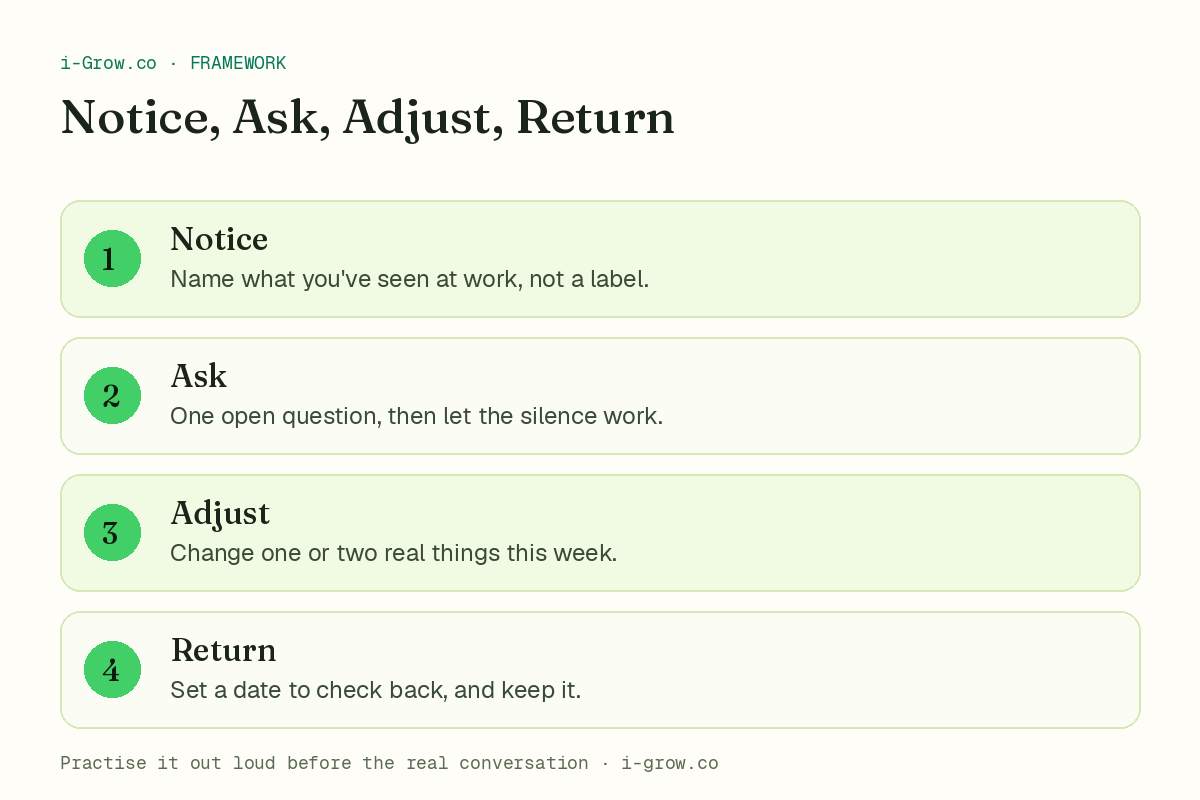
- Notice. Two or three facts from work, with dates. No labels.
- Ask. One open question, then wait. Follow with "What's heaviest right now?"
- Adjust. Change one or two real things this week: move a deadline, cut a meeting, take a project yourself, or reassign a piece.
- Return. Put a date in both calendars and keep it. "Let's check back Tuesday at 10."
Why it works: it keeps you on the parts you control, which are workload, priorities and follow-through. A promise like "let me know if you need anything" puts the work on them, and people who are already stretched rarely take you up on it.
What do you say when they push back?
These are the replies managers hear most, and what to say back.
| They say | You say |
|---|---|
| "I'm fine." | "Okay. I'd still like to take one thing off your plate this week so we don't find out the hard way. Which task can wait?" |
| "Everyone is this busy." | "Maybe. I'm responsible for your workload, so I'm starting with yours. I'll look at the team's separately." |
| "Are you saying I'm not performing?" | "No. This is a check-in about capacity, not a review. If that ever changes, I'll tell you clearly and separately." |
| "I don't want anyone to know." | "I won't share personal details. If we ever need HR to set up support, we'll decide that together first." |
| "There's no one else who can do it." | "Then that's my problem to solve, not yours to absorb. Let's pick what slips while I find cover." |
| "If I slow down, I'll fall behind." | "I'd rather move one deadline now than lose you for a month. Which date can we move?" |
| (Tears, or they shut down) | "Let's take a break. There's no rush. We can pick this up tomorrow, and it's still only about workload." |
The pattern is the same each time: accept what they say, don't argue about whether they're "really" burned out, and come back to one concrete change.
When should you involve EAP or HR, and what do you say?
Mention the EAP early and casually, as a normal resource rather than a referral:
"We also have an Employee Assistance Program. It's confidential, and I don't hear who uses it. A lot of people use it for stress. I'll send you the details after this."
Bring in HR when:
- they mention a health condition, ask about leave, or ask for changes because of a condition (in the US, the Job Accommodation Network explains how accommodation requests work)
- the workload problem is bigger than your team, such as headcount or a company-wide deadline
- you're not sure what you're allowed to offer
What to say: "I'd like to bring in HR so we do this properly. I'll share only what's needed, and I'll tell you before I do."
If they mention self-harm or say they can't go on, stop the work conversation, stay with them and get help now. In the US, call or text 988 to reach the 988 Suicide & Crisis Lifeline. Elsewhere, use your local emergency number.
This article is general guidance for managers, not medical, legal or HR advice. Managers don't diagnose burnout, depression or anxiety. Point people to your EAP, HR and a licensed clinician.
What should you never say?
| Don't say | Why it backfires | Say instead |
|---|---|---|
| "You seem burned out." | It's a label, and it's easy to deny. | "I've noticed late nights and two slipped handoffs." |
| "Just take a day off." | They'll come back to the same pile. | "Let's move Thursday's deadline and cut the weekly sync." |
| "We're all stressed." | It shuts the conversation down. | "I'm starting with your load." |
| "Let me know if you need anything." | It puts the work back on them. | "I'm taking X off your plate today." |
| "Have you tried meditation?" | It's advice about their health, not the work. | "The EAP is there if you want it." |
What should you send the next day?
Send a short message that confirms the changes and the date, and nothing personal:
"Thanks for talking yesterday. As agreed: I've moved the vendor review to the 14th and I'll run Thursday's sync. Let's check back Tuesday at 10. EAP details are here: [link]."
Keep personal and health details out of email and out of your notes. Write down the work changes, who owns them and the date. That's the whole record.
If you lead managers: why this conversation needs practice
Most first-time managers have never run a burnout check-in, and the hardest part isn't knowing the steps. It's staying calm and specific when someone says "I'm fine" and changes the subject. Managers who freeze tend to either drop it or push too hard. Neither helps.
Before the real check-in, have your managers plan it with the difficult conversation planner, and settle their own nerves first with the emotional regulation tracker. It's a self-check for the manager, not therapy. Then have them rehearse it out loud. If you're rolling this out to a group of new managers, book a pilot fit call: the i-Grow.co for Teams pilot is 25 seats for 90 days at $1,500, and individual practice stays private to each manager. L&D sees aggregate skill movement, never transcripts. For more on how first-time managers learn the hard conversations, see first-time manager training.
Rehearse the check-in before you have it
You can read the script five times and still freeze when they say "Everyone is this busy." Saying it out loud is different. On i-Grow.co an AI plays the employee who brushes you off, goes quiet or asks if they're in trouble. You answer in your own words, by voice or text, and then see what you actually said. Start free, no credit card. Your first 3 practice conversations are free.
For the general method, see how to practice difficult conversations. If the conversation later turns into a performance issue, keep it separate and use the underperformance feedback playbook.
Practice this skill
Practise the check-in before the real one
Run the opener and the three hardest replies out loud, privately, before the real conversation. Free to start: 3 practice conversations, no credit card · Private by default.
Rolling this out to a team of new managers? Book a 30-minute pilot fit call →
Frequently asked questions
How do I talk to an employee who seems burned out?
Book a private check-in, name what you've noticed at work (late nights, slipped deadlines, a change in tone), ask one open question, and listen. Offer one or two concrete changes to their workload this week, agree a date to check back, and point them to your EAP or HR for support. Don't diagnose.
Should I use the word burnout?
Usually not first. Name what you've seen instead: hours, missed handoffs, withdrawal. Labels can feel like a diagnosis or a judgment. If they use the word, follow their lead and talk about what would help with the work.
What are the signs of burnout in an employee?
At work you might notice long hours that don't produce more, deadlines slipping for someone who used to hit them, more cynicism or irritability, pulling back from the team, or more time off. These are signs to check in about, not proof of anything. The World Health Organization describes burnout as an occupational phenomenon, not a medical condition.
What if they say "I'm fine"?
Accept it without arguing, and still act: "Okay. I'd still like to take one thing off your plate this week so we don't find out the hard way. Which task can wait?" That keeps the conversation about workload, which is the part you control.
Is a burnout check-in a performance conversation?
No, and say so out loud: "This is about capacity, not a performance review." Keep notes on the work changes and the follow-up date only. If performance becomes a separate issue later, have that conversation separately and clearly.
When should I involve HR or the EAP?
Point people to your Employee Assistance Program any time stress sounds heavy, and involve HR if they mention a health condition, ask for an accommodation or leave, or the workload problem is bigger than your team. If they mention self-harm, stay with them and contact crisis support (988 in the US).
What should I write down after the conversation?
Write the workload changes you agreed, who owns them and the check-in date. Keep personal or medical details out of your notes and out of email. A short follow-up message the next day is enough.
Can I practise a burnout check-in before I have it?
Yes. On i-Grow.co an AI plays an employee who says "I'm fine" or "everyone's this busy." You reply in your own words, by voice or text, and get feedback on what you actually said. The first 3 practice conversations are free.
Sources
- World Health Organization: Burn-out an "occupational phenomenon" (ICD-11), May 28, 2019
- Job Accommodation Network (JAN), US accommodation guidance
- 988 Suicide & Crisis Lifeline (US)
You can't fix how someone feels. You can change what's on their plate, and that's where it starts.