
How Long Should a Manager Coaching Pilot Run? Why 90 Days, Not 30
A 30-day pilot tells you who logged in; a 90-day pilot tells you whether managers handle a real conversation differently.
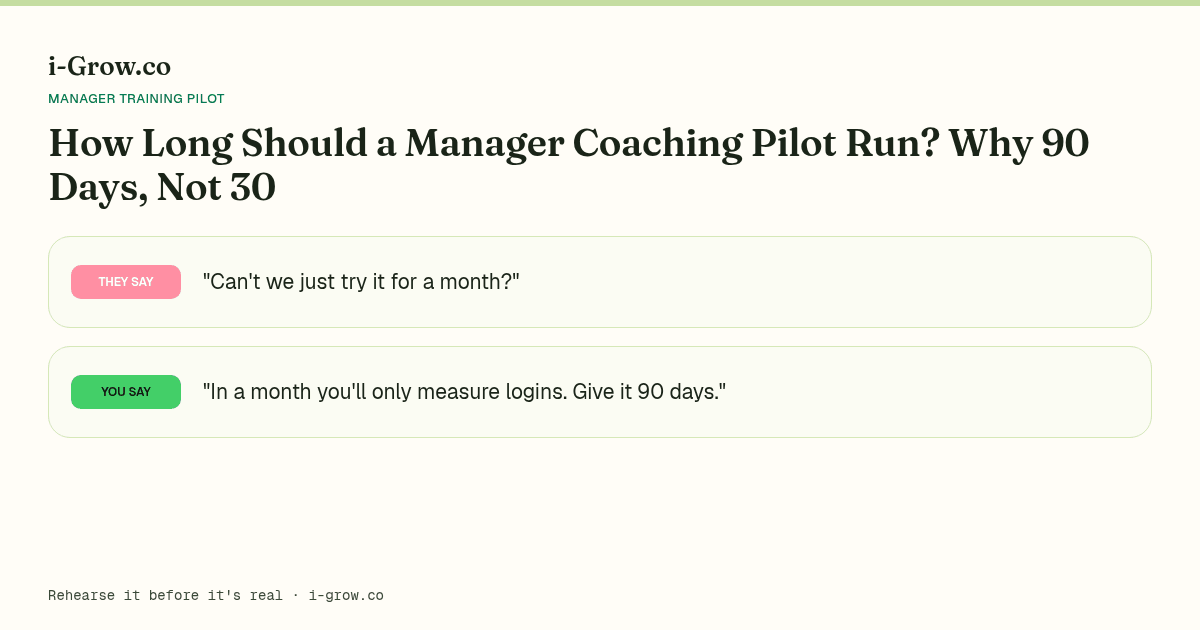
Ninety days, not thirty. A manager-coaching pilot needs three checkpoints — participation at day 30, confidence and a metric review at day 60, on-the-job behavior at day 90 — to show anything beyond logins. A 30-day pilot only has time for the first one.
If you've been asked to "just try a coaching tool for a month," you already know how that story ends: a usage report, a shrug, and no real answer about whether anyone handles a hard conversation differently. The fix isn't a better tool. It's a longer, better-measured pilot — and a specific way to ask your CEO or CFO for one.
Why do most 30-day coaching pilots fail?
They fail because 30 days only has room for one data point: did people log in. A manager might open a tool twice in the first week out of curiosity, never touch it again, and the dashboard still shows "engagement." Nobody has had a real performance review, a real underperformance conversation, or a real reorg conversation in that window — the moments that actually test whether coaching changed anything. So the pilot ends with activity data and no behavior data, and the honest answer to "did it work" is "we don't know yet." That's a hard result to take to a CFO.
The deeper problem is that 30 days measures the tool, not the manager. You can see who clicked. You can't see whether the next layoff conversation, the next promotion denial, or the next performance review went better. Those conversations don't happen on a schedule that fits inside a month.
What is a pilot run (for a training program)?
In aviation, a "pilot" has a narrow, technical meaning. For a training program, it's simpler: a pilot run is a small, time-boxed test of a program with a defined group, a defined length, and a decision point at the end — scale it, change it, or stop. The point of a pilot isn't to prove the program works everywhere. It's to prove, cheaply, whether it's worth rolling out further — and to agree in advance what "worth it" means, so the decision at the end isn't a debate.
That last part is the piece most training pilots skip. Without an agreed metric set at the start, "did it work" becomes a post-hoc argument where everyone remembers the goal differently. The fix is boring but effective: write the success metric down on day 0, before anyone has used anything.
What actually happens at day 30 of a manager-coaching pilot?
Day 30 is early. Most managers in a cohort have had time to log in, try a scenario or two, and form a first impression — but few have hit a real-world moment that tests what they practiced. What you can legitimately read at day 30:
- Participation — how many of the seats have been used, and how many practice attempts logged.
- A first pulse check — a short, quick read on whether the scenarios feel relevant to what managers actually face, not just whether the software works.
What you can't legitimately read at day 30 is behavior change. Nobody has had enough real conversations yet. Treat day 30 as a go/no-go on engagement, not a verdict on the program.
What changes between day 30 and day 90?
Between day 30 and day 90, managers actually run into the conversations the pilot was meant to prepare them for — a real performance review, a real talk with someone who's checked out, a real moment of pushback from a direct report. That's the window where a coaching tool either shows up in how someone handles a hard moment, or it doesn't. Day 60 is where you can ask managers a more honest question than "did you log in": how did a real conversation go, and did you feel more ready going into it. Day 90 is where you — and ideally a skip-level — can look back at a quarter of real conversations and judge whether anything actually moved.
That's the whole argument for 90 over 30 in one sentence: thirty days only tells us whether managers log in. Ninety days tells us whether they handle a real review or a real underperformance talk differently.
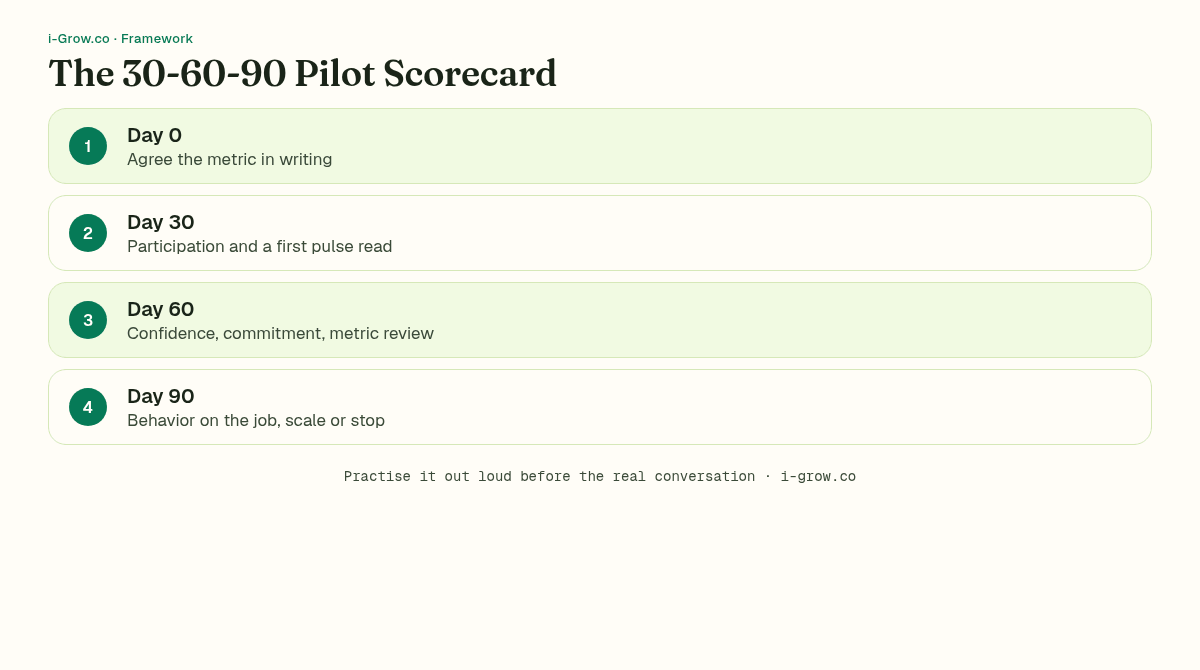
What should you measure at day 30, 60 and 90?
A useful way to think about what each checkpoint can honestly tell you comes from the Kirkpatrick Model, a long-standing framework for evaluating training across four levels: Reaction, Learning, Behavior, and Results. Two pieces of it map directly onto a pilot timeline. First, Level 1 (Reaction) works better as formative pulse checks taken during the program than as a single survey at the end — you want to catch "this doesn't feel relevant" at day 30, not day 90. Second, Level 2 (Learning) isn't just knowledge — it includes confidence and commitment to apply what was practiced, and role play is one of the ways it's measured. Level 3 (Behavior) is the real test: whether people actually use the critical behaviors on the job, not just in a practice session. And the Kirkpatrick framework's "Return on Expectations" idea — that success is defined by key stakeholders in advance, not inferred afterward — is exactly why day 0 matters as much as day 90.
Here's a suggested scorecard built on that logic — not a formula, a starting point to adapt with your own metrics:
| Checkpoint | What to measure | What it tells you | Decision |
|---|---|---|---|
| Day 30 | Participation, practice attempts, first pulse check on relevance | Whether managers are engaging and whether the scenarios feel real | Course-correct messaging or scenarios if engagement is low |
| Day 60 | Confidence and commitment, plus the manager's own read on a real conversation they've had; review against the agreed metric | Whether practice is translating into readiness, not just activity | Decide whether to adjust focus before day 90 |
| Day 90 | Behavior on the job — manager and skip-level read on real conversations; result against the agreed success metric | Whether coaching changed how a real, hard conversation actually went | Scale, extend, or stop |
Three checkpoints, three different questions. Collapsing them into one end-of-pilot survey is how a pilot ends up with a report nobody trusts.
How many seats should a first pilot have?
Big enough to see a pattern, small enough to approve without a committee. A first-line manager cohort should be big enough that a trend at day 60 — three managers independently saying a review went better, two saying a PIP conversation felt less dreaded — reads as a signal rather than a coincidence, but it's still small enough that one HR or L&D leader can sign off without a full procurement cycle. Smaller cohorts can work for a narrow test, but the smaller the group, the harder it is to tell a real pattern from one manager having a good month.
Practice this skill
Try it with one cohort first
Start a 14-day free trial, or book a 30-minute call, before you pitch a longer pilot internally.
Rolling this out to a team of managers? Start a 14-day free trial → or book a 30-minute call with the founders →
How do you decide if the pilot is working before day 90?
You decide using the metric you wrote down on day 0 — not a feeling, and not whatever the dashboard happens to show. The day-60 checkpoint exists specifically so you're not flying blind until the end: we'll check at day 30, 60 and 90 against three things we agree on today, so you're never waiting until the end to know. If confidence and early real-conversation reads look flat at day 60, that's useful information on its own — a chance to adjust scenarios or focus before the pilot closes, not a reason to panic. And if it genuinely hasn't moved by day 60, say so plainly: if it hasn't moved by day 60, we stop there. A pilot that ends on schedule because it didn't work is still a successful pilot — it answered the question it was built to answer, on budget and on time.
The internal pitch: how to ask your CEO or CFO for a 90-day pilot
The hardest part of a coaching pilot is rarely the pilot. It's the five minutes where an L&D leader or COO has to ask a CEO or CFO for budget and 90 days of patience. Three lines tend to do the actual work of that conversation:
"I'm not asking for a company-wide rollout. I'm asking for one cohort and a fixed window, long enough to see a real conversation."
That sentence does the job of shrinking the ask before anyone can inflate it in their head. It's a line item, not a program.
"Thirty days only tells us whether managers log in. Ninety days tells us whether they handle a real review or a real underperformance talk differently."
This is the line that answers "why not just try it for a month" before the CFO has to ask it.
"We'll check at day 30, 60 and 90 against three things we agree on today, so you're never waiting until the end to know."
This is the line that turns "trust us" into "here's exactly when you'll know, and what you'll know."
They say | you say
| They say | You say |
|---|---|
| "Can't we just try it for a month and see?" | "A month only tells us who logged in. We need at least one real review cycle to see if anything changed." |
| "90 days feels like a long commitment for a pilot." | "It's a fixed window, and it ends when that window ends. The commitment is the time, not an open-ended contract." |
| "How do we know it's working before 90 days is up?" | "We check at day 60 against the metric we agree on today. If it hasn't moved by then, we stop there." |
| "What if managers don't use it?" | "That's exactly what the day-30 participation check is for — we'll see low usage early, not find out at the end." |
| "We already ran a workshop this year." | "A workshop teaches a framework once. This is where managers rehearse the actual conversation before they have it — a different, complementary thing, not a replacement for what already happened." |
Limitation: none of this is a guarantee. A pilot — any pilot, from any vendor — can come back flat, and a flat day-60 or day-90 read is a legitimate reason to stop rather than scale. The scorecard above is a way to see that clearly and early, not a way to make the result come out in your favor. And a 90-day pilot still can't prove what happens over a full year; it proves whether a cohort of managers used the practice and whether their real conversations moved on the metric you picked — nothing more, nothing less.
Where i-Grow.co's pilot fits
The timeline above is a way to measure any manager-coaching pilot. It is not a price. To try i-Grow.co with a team, start a 14-day free trial or book a 30-minute call. This page does not quote a program price.
For context on how this compares to a one-off workshop, see i-Grow's broader playbook on first-time manager training and the comparison of AI role play versus manager workshops. If you want the fuller buyer's guide — including a shorter section on running a small pilot in general — start with the AI coach for managers buyer's guide; this page goes deeper specifically on pilot length and measurement. And if the cost of waiting is part of your internal pitch, the cost of bad managers playbook lays out why the status quo isn't free either.
Before you even sign, it's worth running the free leadership diagnostic with a few managers to get a baseline read before day 0 — it costs nothing and gives you something to compare against at day 90.
Practice this skill
Ready to try this with your managers?
Book a 30-minute call with the founders to size a pilot for your team, or start free yourself first.
Rolling this out to a team of managers? Start a 14-day free trial → or book a 30-minute call with the founders →
If you're the one who has to pitch this
You don't have to take any of this on faith before you bring it to your CEO or CFO. Start free with 3 practice conversations, no credit card and run through a performance-review or underperformance scenario yourself, so you know exactly what you're asking your managers to do before you ask for budget. For the performance-review side specifically, performance review training for managers is a good next read. And if you'd rather talk through the pilot length, the seat count, or the metric for your specific team before you write the internal pitch, book a 30-minute call with the founders, or go straight to the 14-day free trial.
A 30-day pilot answers whether people showed up. A 90-day pilot answers whether anything actually changed when it mattered.
Frequently asked questions
What is a pilot run for a training program?
A pilot run is a small, time-boxed test of a training program with a defined group size, a set length, and a decision point at the end: scale it, adjust it, or stop. Unlike aviation's use of the word, a training pilot's goal is to cheaply prove whether a program is worth rolling out further, measured against a success metric agreed on before it starts.
How long should a manager training pilot run?
Long enough to cover at least one real-world test of what managers are practicing — typically 90 days rather than 30. Thirty days only shows whether managers logged in. Ninety days gives time for a real performance review, underperformance conversation, or similar moment to happen, so you can judge whether practice changed how it went.
Why not just run a 30-day coaching pilot?
A 30-day pilot only has room for one data point: participation. It ends before most managers have faced the real conversation the coaching was meant to prepare them for, so the only honest finding at day 30 is 'people logged in,' not 'it worked' or 'it didn't.'
How many seats should a first manager coaching pilot have?
Big enough that a pattern at day 60 reads as a signal rather than a coincidence, and small enough for one HR or L&D leader to approve without a lengthy procurement process. A narrower test is possible, with less certainty in the result.
What should you measure during a 90-day coaching pilot?
Measure different things at each checkpoint: participation and a first relevance pulse check at day 30; confidence, commitment, and a review against your agreed metric at day 60; and actual on-the-job behavior — judged by the manager and ideally a skip-level — against that same metric at day 90.
What happens if the pilot doesn't work?
If results haven't moved by day 60, that's a legitimate reason to stop rather than wait out the full 90 days. A well-structured pilot is built to end cleanly either way, with no auto-renewal, so 'it didn't work' is a clear, budgeted outcome, not a sunk cost.
Do we need to commit to a full rollout after the pilot?
No. A pilot is a single, bounded commitment — one cohort and one length — with a decision point at the end, not the start of an automatic contract. Whether you scale, adjust, or stop depends entirely on how the cohort performed against the metric agreed on at kickoff.
How can a team try i-Grow.co before a longer pilot?
Start a 14-day free trial, or book a 30-minute call to talk through fit. This page does not quote a program price.
Sources
Thirty days proves attendance. Ninety days proves change.