
AI Coach for Managers: A Buyer's Guide for L&D
A practical guide to evaluating AI coaching tools for managers — what they do well, what they shouldn't do, and how to pilot one without betting the budget.
An AI coach for managers is only worth buying if it does one job better than a human can at scale: give a manager unlimited, private reps at a hard conversation before they have it for real. If a vendor can't show you that — a transcript, a privacy model, a measurable skill shift — you're buying a chatbot with a coaching label on it.
What does "AI coach for managers" actually mean?
Vendors use the phrase for three different products, and the differences matter more than the marketing suggests.
Chat advice tools are the largest category. You describe a situation — "my report keeps missing deadlines" — and the AI gives you talking points, scripts, or a framework. Useful for thinking something through. Not useful for finding out whether you can actually say the words out loud under pressure.
Rehearsal or role-play tools put you in a live conversation with an AI playing the other person — the defensive employee, the peer who feels passed over, the report hearing they didn't get the promotion. You practice out loud or by text, the AI pushes back the way a real person might, and you get feedback on what you actually said, not what you meant to say. This is the category i-Grow.co sits in, and it's the one most buyer's guides skip because it's harder to demo in a sales call than a chatbot is.
Performance summary tools sit on top of existing 1:1s, surveys, or review cycles and generate written feedback or dashboards. They're reporting layers, not practice environments.
If you're also sizing up a specific named platform, we've written head-to-head breakdowns on BetterUp and on the broader executive coaching alternatives landscape — this guide covers the category, not one vendor.
What does an AI coach for managers do well?
The honest list is shorter than most vendor decks, but it's real:
- Unlimited repetition. A manager can run the same difficult conversation five times in a week before the real one. No human coach's calendar supports that.
- Privacy that makes practice possible. Managers rehearse badly when they think someone's judging them. An AI that doesn't report individual transcripts to a boss removes that fear — see our AI role-play vs. manager workshops comparison for why that privacy model changes behavior, not just comfort.
- Consistency across a cohort. Every manager in a pilot gets the same difficulty of pushback, which makes before/after comparisons meaningful in a way "I had a great coach" testimonials never are.
- On-demand availability. Ten minutes before a real conversation, on a phone, at 9pm — not a scheduled hour three weeks out.
- A starting point for people who've never had a framework. Our own leadership diagnostic is free precisely because most first-time managers haven't been taught to name what they're avoiding, let alone rehearse it.
What can't — and shouldn't — an AI coach do?
This is the section most vendor pages leave out, and it's the one that should drive your evaluation.
Limitation: an AI coach should never be the system of record for an employment decision. If a manager is building toward a termination, a PIP, or a leave accommodation, the documentation, the legal review, and the final judgment calls belong to HR and legal — not to a rehearsal tool. Our PIP conversation simulator exists to help a manager practice delivering language that's already been approved through your process — it's rehearsal, not a substitute for HR sign-off or legal review of accommodation requests.
Limitation: it shouldn't give medical, legal, or accommodation advice, full stop. Questions about what a disability accommodation requires, or what documentation an attorney would want, need a human who's trained and accountable for the answer — not a model generating a plausible-sounding one.
Limitation: it doesn't replace senior-level human coaching. A rehearsal tool is built for the volume problem — hundreds of first-time managers who've never had the budget for an executive coach. A VP navigating a board-level conflict needs a human who can read the politics in a room, not a model playing a role.
Limitation: it can't tell you whether a manager's underlying judgment is sound — only whether their language, tone, and response to pushback hold up under practice. A manager can ace every rehearsal and still make a bad call. Treat skill movement as one input to a promotion or coaching decision, never the whole picture.
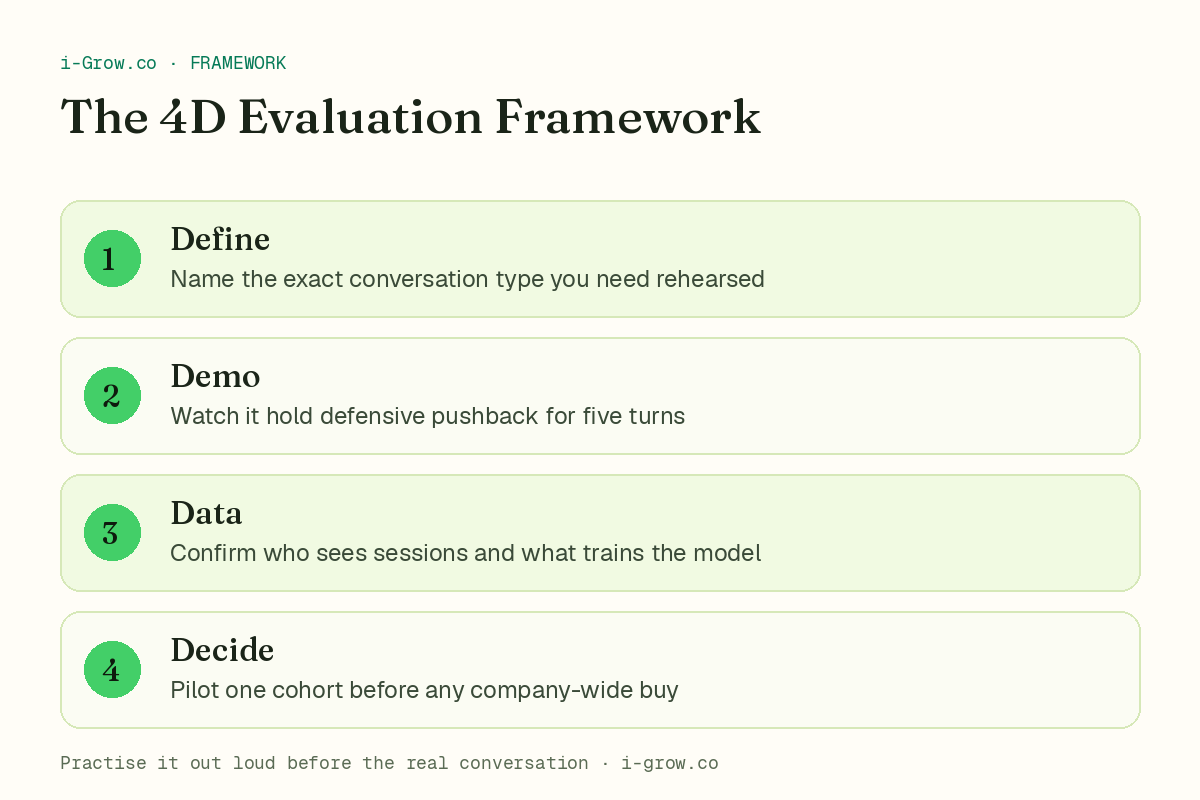
What should L&D ask before buying? A 10-question checklist
Most AI coaching demos are built to look good for ten minutes. These questions are built to find out what happens in month three.
- "Show me a transcript where the AI stays defensive for five turns, not two."
- "Who can see an individual manager's practice — their boss, HR, or no one?"
- "Is our data used to train your models, or is it walled off from us?"
- "What do you report to us — completions, or actual skill movement?"
- "Can it handle the specific conversation types we need, not just generic feedback?"
- "What happens when a manager tries to get the AI to agree with something inappropriate?"
- "How long does it take a manager to start a session — one click, or a scheduling cycle?"
- "What's your security questionnaire timeline, and can you complete ours before kickoff?"
- "What does a manager see right after a session — written feedback, a score, or nothing?"
- "If we don't renew, what happens to our data?"
Ask every vendor the first question live, on the call. A tool that can only produce a polite, two-turn disagreement before the AI "resolves" the conflict isn't rehearsing the conversation your managers are actually afraid of — it's rehearsing a cooperative one.
Practice this skill
Rehearse one hard conversation first
Try a free ten-minute rep with an AI that stays defensive — feedback that might sting, opening a PIP, or re-engaging a checked-out performer.
Rolling this out to a team of new managers? Book a 30-minute pilot fit call →
How do you handle the predictable pushback on buying this?
Every L&D buyer hears some version of these four objections. Here's how to answer them honestly, without overselling what the tool does.
| They say | You say |
|---|---|
| "We already have LinkedIn Learning." | "That teaches concepts. It doesn't tell a manager whether they can actually hold their ground when an employee gets defensive — that only shows up in practice." |
| "We have executive coaches." | "Keep them for senior leaders and high-stakes situations. Rehearsal tools solve the volume problem — every first-time manager, not just the ones with a coaching budget." |
| "What's the legal risk?" | "Keep it low by positioning the tool as practice, not documentation or advice, and put that in your policy. Ask the vendor directly how they draw that line — see question 1 and question 3 above." |
| "Will managers actually use it?" | "Only if sessions are short and private. Ten-minute reps that never reach a manager's boss get used; hour-long modules that get reported upward don't." |
How do you run a small pilot before a company-wide rollout?
Don't buy a seat license for the whole management layer on a demo. Structure a pilot that actually tells you something:
- One cohort. A single team or department, not a volunteer grab-bag from across the company — you want a group whose managers you can compare before and after.
- One or two conversation types. Pick the hardest, most common conversation your managers avoid — underperformance feedback is the usual answer — and rehearse that, not everything at once.
- A fixed window. Four to twelve weeks, with a clear start and end date, so "did this work" has an actual answer instead of becoming an open-ended subscription nobody revisits.
- A before/after readiness check. Some way to compare how a manager handles the conversation at week one versus week eight — even a simple self-rated confidence check beats no baseline at all.
Here's how i-Grow.co's own pilot is structured, so you can hold any vendor's pitch against a real example: 25 seats, 90 days, $1,500, live in under a week. Managers practice in ten-minute reps, in a browser or on a phone. Individual sessions stay private to the manager who practiced them — L&D sees aggregate skill movement across the cohort, never a transcript, and nothing about a manager's practice is shared with their boss. We complete security questionnaires before kickoff rather than after you've already signed. If you want to see the model before you commit to it, book a 30-minute fit call and ask us question 1 directly.
For the case to bring to your own leadership on why this is worth piloting at all, our cost of bad managers playbook lays out the argument without needing a vendor-specific ROI worksheet. And if you want the fuller picture of what a first-time-manager program looks like beyond one tool, see first-time manager training.
Where does human coaching still win?
Be honest with your leadership about this, because overselling AI coaching is how pilots lose credibility in month two. Human coaches win when the situation is political rather than procedural — a VP managing a peer conflict with another executive, a leader navigating a reorg where the "right" answer depends on relationships an AI can't see. They win when judgment, not language, is the gap: knowing whether to have a conversation at all, not just how to phrase it. And they win for anyone whose stakes are high enough that a trusted, accountable human relationship matters more than unlimited reps. An AI coach's job is to make sure every manager — not just the ones with an executive coaching budget — gets to practice before the moment that matters. It's a volume tool, not a replacement for judgment.
If you want to see what the rehearsal category looks like in practice before you sit through another vendor demo, read how AI role-play communication training actually works, or try one rehearsal yourself — three free sessions, no credit card — so you know exactly what you're asking your managers to do before you buy seats for them.
Practice this skill
Pilot this with one cohort, not the company
Book a 30-minute fit call to scope a 25-seat, 90-day pilot. Free to start: 3 practice conversations, no credit card · Private by default.
Rolling this out to a team of new managers? Book a 30-minute pilot fit call →
Frequently asked questions
What's the difference between an AI coach and an AI chatbot for managers?
A chatbot gives advice when asked. An AI coach built for rehearsal puts you inside a live conversation — the AI plays the other person, pushes back, and you practice what you'd actually say under pressure, then get feedback on your words, not just a tip sheet.
Can an AI coach replace a human executive coach?
No, and it shouldn't try to. AI coaching tools solve a volume problem — giving every manager, not just senior leaders, unlimited practice reps. Human coaches still win on political, high-stakes, or judgment-heavy situations where a trusted relationship matters more than repetition.
Is it safe to use AI coaching for sensitive conversations like PIPs or terminations?
It's safe for rehearsing delivery of language your HR and legal teams have already approved. It's not safe as the system that decides the employment action itself — that documentation and judgment call should always stay with accountable humans.
Who sees the transcripts from a manager's practice session?
That depends entirely on the vendor's privacy model, which is why it belongs at the top of any evaluation checklist. At i-Grow.co, individual sessions stay private to the manager; L&D sees only aggregate skill movement across a cohort, never a transcript or a manager's boss.
How long should a pilot run before we decide to scale it?
Long enough to see a before/after difference, short enough to stay cheap if it doesn't work — most L&D teams land on four to twelve weeks with one cohort and one or two conversation types. i-Grow.co's standard pilot runs 90 days across 25 seats.
Does the AI ever actually push back, or does it just give advice?
In a rehearsal tool, yes — that's the point. The AI plays the defensive employee, the resistant peer, or the person getting hard news, and should stay difficult for several turns. If a vendor's demo resolves the conflict in two turns, ask why.
What conversation types can i-Grow simulate today?
The team library covers giving feedback that might sting, opening a PIP, delivering a layoff or termination, re-engaging a checked-out performer, addressing how someone treats the team, and facing the team after a reorg, by voice or text, in ten-minute reps. If you need a type that's not listed, ask directly on a fit call rather than assuming from the website.
How much does a pilot cost, and what's included?
i-Grow.co's team pilot is $1,500 for 25 seats over 90 days, live in under a week, including a security questionnaire completed before kickoff — small and fast enough to evaluate honestly before any larger commitment.
Sources
A manager who's rehearsed the hard sentence once is calmer than one who's only read advice about it.