
How to Give a Verbal Warning to an Employee (Word-for-Word Script)
A step-by-step script and documentation template for managers who need to deliver a verbal warning fairly and clearly.
A verbal warning is a short, formal conversation where you name a specific behavior, state the standard you expect, give a timeline, and document it afterward — distinct from a casual comment because you say out loud that it's a formal step and you write it down the same day.
This isn't legal advice. Follow your company's HR policy and talk to HR before you give a formal warning — the steps below are a communication framework, not a substitute for your policy.
What is a verbal warning, and when do you use one?
A verbal warning is often the first formal step in a progressive discipline process — the point where a pattern of behavior (lateness, missed deadlines, tone with the team, a policy violation) moves from "I mentioned it" to "this is on record." You use one when you've already raised the issue informally at least once, or when the behavior is serious enough that informal doesn't cover it. If the issue is purely attendance, see the lateness-specific version of this conversation. If it's a broader performance pattern, underperformance feedback covers how to frame the standard before you get here.
How is a verbal warning different from a casual heads-up?
The difference isn't tone — it's formality and documentation. A casual heads-up disappears if nothing's written down. A verbal warning is still a conversation, but you name it, and you document it.
| Casual heads-up | Verbal warning | Written warning | PIP | |
|---|---|---|---|---|
| Purpose | Nudge behavior early | Formally flag a pattern | Create a paper trail | Structured path to improve or exit |
| Documented? | No | Brief note to file | Formal letter, often signed | Formal plan with milestones |
| Who's involved | You and them | You, sometimes HR | You and HR | You, HR, often your manager |
| What comes next | Usually nothing, if it's fixed | Written warning if it repeats | PIP or further discipline | Improvement or separation |
What is the proper procedure for issuing a verbal warning at work?
Follow your company's policy for the exact steps required where you work. The general shape most policies follow:
- Check your policy first. Talk to HR before you schedule anything formal — some companies require HR to be looped in before step one.
- Prepare. Write down the specific behavior, dates, and the standard you expect. Vague notes make for a vague conversation.
- Meet privately. No warning should happen in front of the team, in a group chat, or in passing.
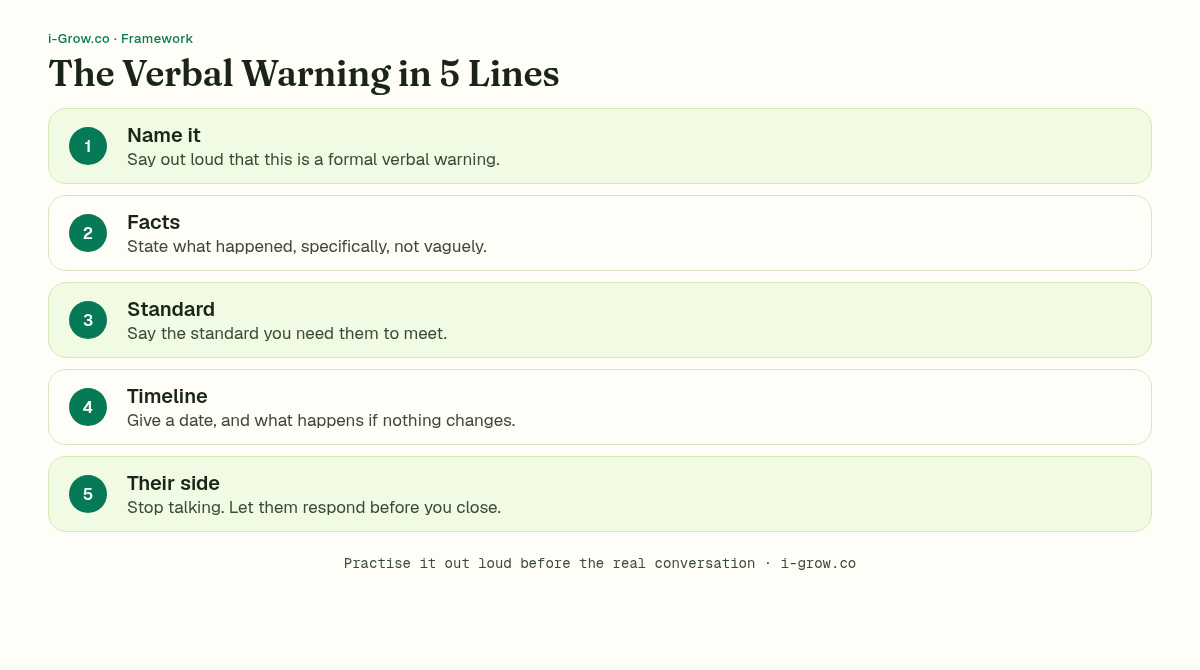
- State it plainly. The issue, the standard, the timeline, the consequence — in that order.
- Let them respond. Actually listen before you close the conversation.
- Document it same day. Memory fades fast; write the note while it's fresh.
- Follow up on the date you set. Regardless of outcome — improvement or not.
What should you say? The verbal warning script
Here's the shape of the conversation, line by line. Adjust the brackets, keep the structure.
Opening — name it
"I need to flag something formally — this is a verbal warning about [specific behavior]."
The facts and the standard
"Here's what's happened, here's the pattern, and here's the standard I need you to meet."
Why this isn't a surprise
"This isn't a surprise — we've talked about [related incident] before."
The timeline and the consequence
"If this doesn't change by [date], the next step is a formal written warning — I want you to have the chance to fix it before that."
Their side
"What's going on from your end? I want to hear it before we close this out."
The close
"To be clear — this is a verbal warning, I'm writing a short note about it today, and I believe you can turn this around by [date]."
Practice this skill
Practise the warning before you give it
Run the actual conversation with an AI that pushes back, then see where your language got vague.
Rolling this out to a team of managers? Start a 14-day free trial → or book a 30-minute call with the founders →
What should you do when they push back?
People rarely sit quietly through a warning. Have your responses ready before you walk in.
| They say | You say |
|---|---|
| "Does this go in my file?" | "Yes — a short note, not a long write-up. I'll show you what it says." |
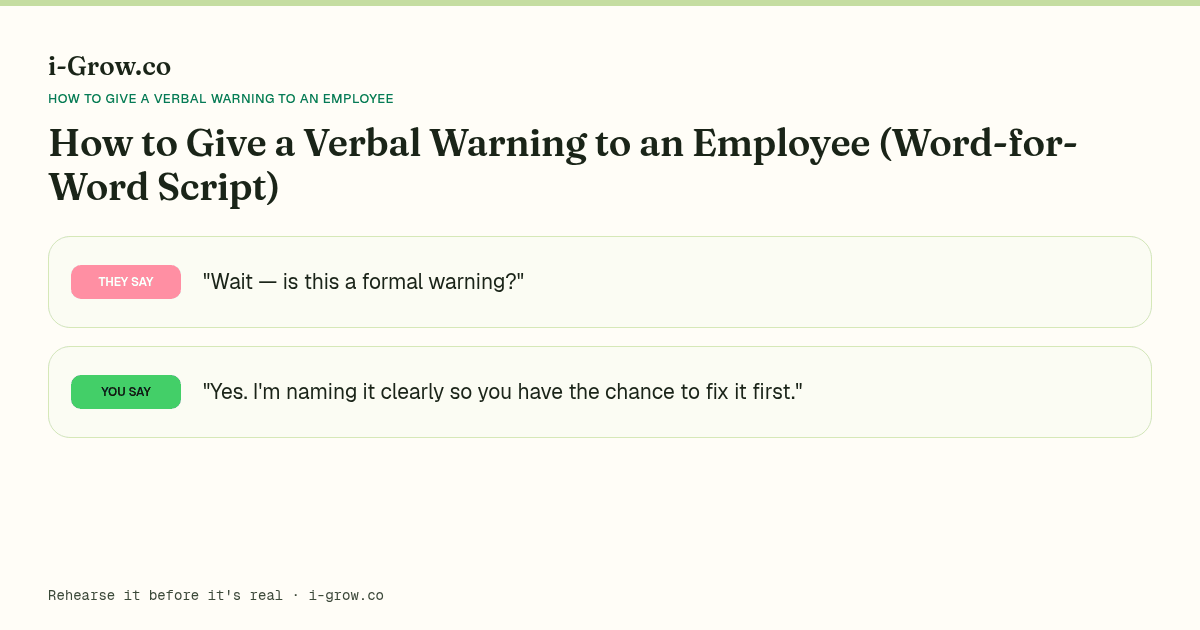
| "I didn't realize this was a formal step." | "That's exactly why I'm naming it clearly now — so there's no confusion later." |
| "What happens if it happens again?" | "The next step is a written warning. I'd rather it not get there." |
| "This is unfair — other people do it too." | "If I see it from someone else, I'll address it the same way. Right now, this conversation is about you." |
| "Can I have someone with me?" | "Let me check what our policy says and get back to you before we go further." |
| [Silence] | "Take your time. I'll wait." |
If the conversation turns emotional rather than defensive, what to do when an employee cries during feedback covers how to hold the line without rushing past it.
Verbal warning examples: what to say in four common situations
Repeated lateness
A verbal warning fits once lateness has happened more than once or twice in a short period and a casual reminder hasn't changed anything.
"This is a verbal warning. I've noticed you've clocked in after [9:15am] on [three days this past week], and I wanted to flag it directly. Starting today, I need you here by [9:00am] — can you tell me what's getting in the way?"
Watch for: pushback that other people are late too, or that the lateness is only a few minutes — stay focused on the specific pattern you documented, not a comparison to coworkers. See the lateness-specific guide for more on handling this conversation.
Missed deadlines
A verbal warning fits when someone misses a deadline without flagging it in advance, especially once it has happened more than once.
"This is a verbal warning. The [Q3 report] was due [Friday] and I didn't hear from you until [Monday]. Going forward, I need to know as soon as something's going to slip, even if it's just a heads-up the day before. What happened this time?"
Watch for: an explanation that shifts the blame to unclear scope or another team — acknowledge it if it's fair, but separate "the deadline was unclear" from "I didn't tell you I'd miss it."
Tone with teammates
A verbal warning fits when a pattern of sharp or dismissive comments has been reported or observed more than once, not after a single heated moment.
"This is a verbal warning. A couple of people have mentioned that your tone in [meetings and Slack] has come across as dismissive lately, and I noticed it myself during [the planning call on Tuesday]. I want to raise it now, before it affects how the team works with you."
Watch for: "that's just how I talk" or a demand to know exactly who complained — hold the boundary on the behavior change you need without promising anonymity you can't actually guarantee.
A policy breach
A verbal warning fits for a first-time skip of a required step — like a safety check or a security protocol — where the intent wasn't malicious but the step still can't be optional.
"This is a verbal warning. I saw that [the lockout step] wasn't completed before [the machine was serviced on Wednesday]. That step is required every single time, with no exceptions, and I need to see it followed starting now."
Watch for: "it's never caused a problem before" — the point of this conversation is that the step is mandatory regardless of past outcomes, not that something already went wrong this time.
If the behavior could involve a legal or safety issue, talk to HR before the conversation.
What should you document after the conversation?
Even though it's called "verbal," write it down the same day. Cover:
- Date, time, and location of the conversation
- The specific behavior and the dates it happened
- The standard you communicated
- The timeline you gave them
- What they said in response
- The consequence if nothing changes
- Who else, if anyone, was present or copied
A verbal warning usually isn't a letter — it's a short confirmation note or email. Here's a template:
Subject: Following up on our conversation today
Hi [Name],
Following up on our conversation on [date]. We discussed [specific behavior/pattern]. Going forward, I need to see [standard]. If this doesn't change by [date], the next step would be a formal written warning. Let me know if you'd like to add anything to this note.
[Your name]
Check with HR on whether your company requires this note to be sent to them as well as the employee.
Can someone be fired after a verbal warning?
It depends on your company's policy, the employee's contract, and local law — this is not legal advice, and you should check with HR or employment counsel before assuming either way. Many U.S. jobs are at-will, but many employers also have a progressive discipline policy, in which a verbal warning is often step one, not the end of the road. If the pattern continues past a written warning and a PIP, and it does get to a termination conversation, what to say when firing someone covers that conversation directly.
How does this connect to a PIP if nothing changes?
If the behavior doesn't change by the date you set, the next step is usually a written warning, and from there, a formal improvement plan. The PIP conversation walks through how to open that conversation once you're past verbal and written warnings — the structure is similar, but the stakes and the documentation go up.
What should you avoid saying?
A few lines that quietly undercut the warning you're trying to give:
- "This is just a heads-up." It isn't — and saying so tells them not to take it seriously.
- "Everyone does this, don't worry about it." It minimizes the exact standard you're trying to set.
- "I probably shouldn't even be bringing this up." It erodes your own authority before you've started.
- "If it happens one more time, you're fired." It overstates the consequence and sets up a bluff you may not be able to keep.
- "Don't take this personally." It is personal to them — say what you actually mean instead.
- "I'm sure it won't happen again." It removes the accountability you just asked for.
Practise it before you say it
The script above reads easily on a page. It's harder to hold the line out loud when someone pushes back, goes quiet, or gets defensive. The difficult conversation planner helps you map the conversation before you have it, and the PIP conversation simulator lets you run the next step after a verbal warning, if it comes to that. For a broader look at rehearsing conversations like this one, see how to practice difficult conversations.
With i-Grow.co, you can start free, no credit card and run this exact warning against an AI that pushes back the way a real employee might — before you're standing in front of the real one.
If you're in HR or lead a team of managers, the harder problem usually isn't one warning — it's every manager giving a different version of it, some too soft, some too sharp, none documented the same way. A 14-day free trial lets them rehearse this conversation before they give it. Book a 30-minute call to talk through whether that fits your team.
Practice this skill
Say it clearly the first time
Start free — no credit card — and practise your next verbal warning before you walk into the room.
Rolling this out to a team of managers? Start a 14-day free trial → or book a 30-minute call with the founders →
Frequently asked questions
Can I get fired after a verbal warning?
It depends on your company's policy, your contract, and local law — this isn't legal advice. Many U.S. jobs are at-will, but many employers describe progressive discipline steps in their policy. Ask HR what your company's policy says before you assume either way.
How do you issue a warning to an employee?
Check your policy, then prepare specifics: the behavior, dates, and the standard you expect. Meet privately, name it as a formal verbal warning, state the facts and timeline, let them respond, and document the conversation the same day.
What is the proper procedure for issuing a verbal warning at work?
Follow your company's HR policy first. Typically: prepare your notes, meet privately, state the issue and the standard clearly, give a timeline and consequence, let the employee respond, document what was said, and follow up on the date you set.
Can you provide an example of a verbal warning letter?
A verbal warning usually isn't a formal letter — it's a conversation followed by a short written note or confirmation email. A typical note says: 'Following up on our conversation on [date] about [behavior]. I need to see [standard] by [date].'
What's the difference between a verbal warning and a written warning?
A verbal warning is a conversation you briefly document in a note; a written warning is a formal letter, usually reviewed by HR and signed, that goes further in a company's discipline process. A verbal warning typically comes first.
Do you have to document a verbal warning?
Yes — even though it's called 'verbal,' write a short note or email the same day covering what was discussed, the standard, and the timeline. Check your company's policy for exactly what's required and whether HR needs a copy.
What should you say in a verbal warning?
Name it clearly as a formal verbal warning, state the specific facts and pattern, repeat the standard you expect, give a date and consequence, then stop talking and let the employee respond before you close the conversation.
Can an employee refuse to acknowledge a verbal warning?
They can disagree with it. Note their disagreement in your write-up and ask HR how your company records a warning the employee disputes or declines to acknowledge. If they ask for someone else present, check your company's policy before answering — don't promise either way on the spot.
Sources
A warning that isn't named clearly isn't a warning — it's a conversation someone will forget.