
Training Cost per Employee for Manager Development: How to Budget It
Skip the industry benchmark — here's a worksheet to find your real training cost per manager before you commit a full budget line.
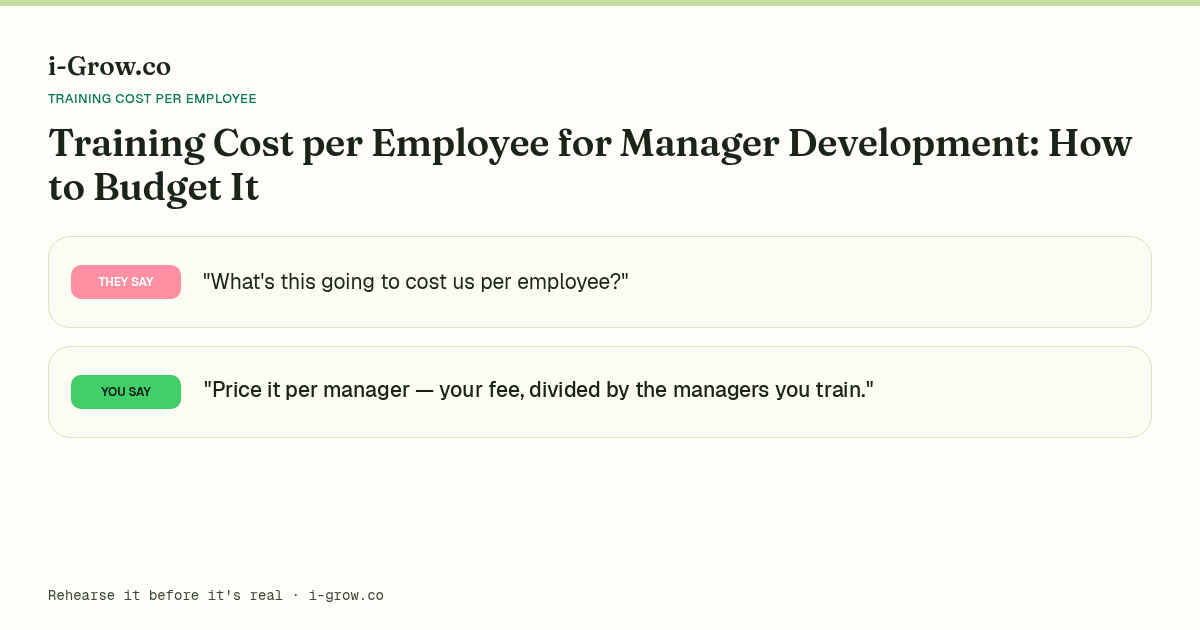
Training cost per employee for manager development equals total program cost — direct fees, manager time, and admin overhead — divided by managers trained. Skip the industry benchmark: your real spend and your real managers are the numbers finance will ask about, and a small pilot gets you there faster than a guess.
How do you calculate training cost per employee?
The formula is simple, even if the inputs take some digging:
Total program cost ÷ number of participants = cost per employee (or, for manager development, cost per manager).
Total program cost breaks into four lines: direct fees (what you pay a vendor, or a license cost), internal time (hours spent in or preparing for training, multiplied by a loaded hourly cost), travel and materials if any apply, and admin — the HR or L&D hours it takes to run the thing.
Here's the worksheet. Fill in your own numbers — don't borrow anyone else's benchmark, because your managers, your pay bands, and your program aren't the same as whatever a generic industry average was built from.
| Line item | What to enter | Your number |
|---|---|---|
| Direct fees | Vendor invoice, license, or flat program fee | $____ |
| Manager time | Hours spent training × loaded hourly rate | $____ |
| Travel & materials | Venue, travel, printed materials, if any | $____ |
| Admin & coordination | HR/L&D hours to run it × loaded rate | $____ |
| Total program cost | Sum of the above | $____ |
| ÷ Managers trained | Number of participants | ____ |
| = Cost per manager | Total ÷ managers trained | $____ |
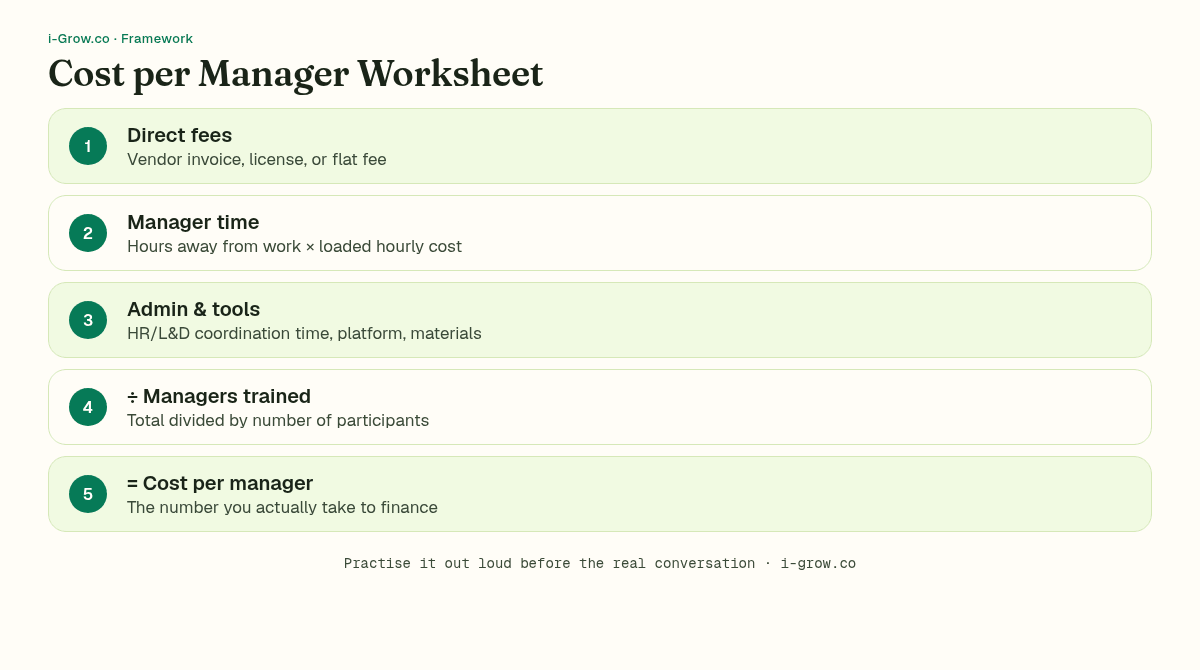
A worked example, using a figure you plug in yourself — an illustration, not an i-Grow price. Suppose the direct-fee line is $2,400 for 10 managers, and managers practise in ten-minute reps in the browser or on a phone. The direct-fee math alone is $2,400 ÷ 10 = $240 per manager. Swap in your own fee and your own headcount, then add your admin time on top, and you have a complete number — not someone else's benchmark, yours.
Why cost per manager is the number that matters, not cost per employee
Cost per employee is the wrong denominator for manager development, because it dilutes the number across people who never manage anyone. The relevant unit is the manager, because a manager's behavior in one conversation — a feedback session, a PIP, a layoff, a performance review — shapes how every one of their direct reports experiences the company. Bad management compounds; the real cost of a bad manager isn't the manager's salary, it's the turnover and disengagement of everyone underneath them. Budgeting per manager keeps that multiplier visible instead of burying it in a company-wide average.
What is the 70/20/10 rule, and what does it mean for your budget?
The 70/20/10 rule is a widely cited rule of thumb: roughly 70% of a manager's development comes from on-the-job experience, 20% from other people and feedback, and 10% from formal courses. It's a heuristic people reach for in planning conversations, not a measured finding you can cite as fact.
Limitation: treat 70/20/10 as a planning guide, not an audit standard — nobody has measured your specific team against it, and it shouldn't be the sole justification line in a budget memo.
What it does suggest, even as a rough guide, is that a budget made up entirely of formal courses is lopsided. If 70% of development is supposed to come from experience, a line item that lets a manager practice the actual hard conversation — not read about it — deserves real weight next to course spend.
What's hidden in "cost" — manager hours, and the hours of the people they manage
The direct-fee line is the easy part. The hidden costs are the hours a manager isn't doing their job while they train, and — one step further — the hours their team spends dealing with a manager who hasn't had the practice yet. A manager who freezes in a termination conversation, or avoids a PIP for two quarters, is generating cost in every one-on-one they have in the meantime. That cost never shows up on an invoice, which is exactly why it gets left out of budget conversations.
If you want to see where your own managers' gaps actually are before you size a budget around closing them, the free leadership diagnostic is a free way to find out, with no commitment attached.
How does a pilot change the math compared with a full rollout?
A full rollout forces you to estimate a cost-per-manager number before you have any real data — you're pricing a guess. A pilot flips that: you run a small, real cohort, get an actual cost-per-manager figure and actual usage data, and then decide whether to scale with a number you trust instead of one you projected. It's also just a smaller number to get approved. If you want to see how enterprise coaching pricing generally compares before you commit to a per-seat model, here's how i-Grow stacks up against BetterUp-style coaching on structure, not just price.
If you want to see the practice before you commit a budget, you can start a 14-day free trial or book a 30-minute call to talk it through against your own headcount.
Practice this skill
See the real number before you budget the big one
Start a 14-day free trial and see the practice before you budget the rollout.
Rolling this out to a team of managers? Start a 14-day free trial → or book a 30-minute call with the founders →
How do you try the practice before you commit a budget?
Start a 14-day free trial, or book a 30-minute call to talk through fit. The worksheet above is where your own fee and headcount go. This page does not quote a program price.
What should you ask a vendor before you commit budget?
Before you sign anything bigger than a pilot, get clear answers on:
- Is pricing per seat or a flat program fee — and does that change at scale?
- Is there a seat minimum, and what happens if you're under it?
- Does the contract auto-renew, or does it end on a fixed date unless you act?
- What specific metric gets measured, and who agreed to it — the vendor, or you?
- Who sees individual results, and who sees only aggregate movement?
- Does it require IT integration, or does it just work in a browser?
- Can seats be reassigned if a manager leaves or changes role?
- What does exit actually look like — is there a clean stop, or a wind-down cost?
Expect pushback as you take these questions back to your own team — here's how to handle the common ones:
| They say | You say |
|---|---|
| How does that compare to individual coaching per employee? | We're not pricing against competitors here — individual coaching is typically billed per person, while a cohort program spreads one fee across the managers in it. Plug that fee into the worksheet. |
| What if the first group is the wrong size? | Start with a group large enough to see a pattern. A different size can be talked through on a call before anyone locks a larger budget. |
| Can finance see a breakdown before approving more? | Yes — agree the metric before you start, and bring back usage and progress against it before anyone signs anything bigger. |
| Why not just buy an LMS course library? | A course library teaches concepts. It doesn't put a manager through the actual hard conversation and tell them, line by line, what they said. |
| What about the time managers spend practising? | Managers practise in ten-minute reps in the browser or on their phone — not a day out of the calendar. |
For the per-person coaching comparison specifically, executive coaching alternatives is worth a look if someone on your team raises it — the pricing model, not just the price, is the real difference.
How do you justify the spend to finance?
The strongest version of this conversation doesn't start with a company-wide number. It starts small and gets specific:
"Before we roll this out company-wide, I want to run a small pilot and see the real cost per manager."
"I'd rather prove it on a small group, with our own fee divided by our own managers, than estimate a big-group price."
"Let's agree now what 'worked' means, so the number we take to finance next time is real, not a guess."
That last line matters more than the first two. A pilot without an agreed success metric just produces a feeling, and feelings don't survive a budget review. A pilot with a metric agreed at kickoff produces a number — and a number is what gets a bigger line item approved the second time around.
If you want a sense of how this compares to running the training in-house versus bringing in live workshops, the first-time manager training playbook and AI roleplay versus manager workshops walk through the trade-offs in more depth than a pricing page can.
Define "worked" before you spend — Kirkpatrick's Return on Expectations
Kirkpatrick's model has a useful term for this: Return on Expectations, or ROE. ROE is defined by the key stakeholders — not by the vendor, and not after the fact — and it's established in advance, before the program runs. The same source makes a point worth sitting with: in a complex system, results are rarely caused by a single program. A manager's performance after a pilot is shaped by their team, their own tenure, their workload, and a dozen other things besides the training.
That's exactly why the agreed metric matters more than a clean-sounding ROI story. You're not trying to prove the pilot alone caused everything that happened in the next 90 days — you're trying to see whether the specific thing you and the vendor agreed to watch for actually moved. If you want more on how to read manager development spend against actual outcomes rather than vendor claims, the buyer's guide to AI coaching for managers covers what to ask for in that report.
Practice this skill
Price it per manager, not per employee
Start free, or start a 14-day team trial and fill the worksheet with your own numbers.
Rolling this out to a team of managers? Start a 14-day free trial → or book a 30-minute call with the founders →
A training line that finance approves twice is one that was proven once, on a small group, against a number everyone agreed to before it started. Price it per manager, on your own fee and your own headcount — not a benchmark borrowed from somebody else's org chart.
Start free, no credit card if you want to see what a single manager's practice session looks like before you start a 14-day free trial.
Frequently asked questions
How do you calculate training cost per employee?
Add direct fees (vendor, license, or flat fee), internal time (hours spent times loaded hourly cost), travel or materials, and admin coordination time. Divide that total by the number of people trained. For manager development, run this per manager, not per employee — managers are the multiplier that affects everyone who reports to them.
What is the 70/20/10 rule for training?
It's a widely used rule of thumb suggesting roughly 70% of development comes from on-the-job experience, 20% from others and feedback, and 10% from formal courses. It's a heuristic, not a measured law — treat it as a planning guide, not an audit standard. It does suggest that practice-based budget lines deserve real weight next to course spend.
How much does a $20 an hour employee cost an employer?
More than the wage alone — payroll taxes, benefits, and overhead typically push total cost above the hourly rate, but the exact multiplier varies by company and should come from your own finance or HR data, not a generic rule. That matters here because manager time spent training is also a real cost, not a free hour.
How can a team try the practice before budgeting a rollout?
Start a 14-day free trial, or book a 30-minute call to talk through fit. Use the worksheet on this page for your own fee and headcount. This article does not quote a program price.
Why does cost per manager matter more than cost per employee?
A manager's behavior shapes every conversation their direct reports have about their job — feedback, recognition, conflict, growth. One manager's cost touches many employees' experience. Budgeting per manager keeps the real multiplier visible, instead of diluting it across a headcount number that includes people who never manage anyone.
How do you justify a manager training budget to finance?
Bring a small, real number instead of an estimate: run a pilot, agree on a success metric in advance, and report the actual cost per manager plus what moved. Finance approves real numbers faster than projections, and a pilot-sized spend is easier to approve than a full rollout commitment.
What if the first group is the wrong size?
Start with a group large enough that a pattern reads as a signal. If you need a different size, book a 30-minute call and talk it through before you commit a larger budget. The worksheet is where you put your own cost per manager.
Can pilot seats be reassigned if a manager leaves or changes role?
Ask whether a place in the cohort can move if a manager leaves or changes role. A fixed window can span a reorg or a departure, and you do not want turnover to inflate your per-manager cost.
Sources
A budget line finance believes is one you've already proven — on a small group, not the whole company.