
Stay Interview Questions: A Script Managers Will Actually Use
A stay interview only works if the questions are specific and the manager knows what to say when the answers get uncomfortable.
A stay interview is a 20-to-30-minute, one-on-one conversation where a manager asks a direct report why they stay, what might pull them away, and what would make work better — scheduled on its own, not bolted onto a performance review or a comp conversation. Done well, it surfaces a flight risk early enough to act on. Done badly, it's a checklist item nobody follows up on, and employees learn fast which one they got.
What a Stay Interview Is (and Isn't)
A stay interview is a retention tool, not an evaluation. The manager isn't grading the employee — the employee is grading the job, and the manager is taking notes.
It isn't a performance review. No scores, no ratings, no "areas for growth." If you combine the two, people will answer the stay-interview questions the way they answer review questions: carefully, defensively, and short.
It isn't a raise meeting. Compensation will come up — it almost always does — but the stay interview isn't where it gets decided. Treat it as a fact-finding conversation that might feed a comp conversation later, not a substitute for one.
It also isn't an exit interview run early. An exit interview happens after someone has already decided to leave, when the only thing you're collecting is a post-mortem. A stay interview happens while the person is still deciding, which is the only point at which anything you learn can change the outcome. Richard Finnegan, whose books and SHRM articles on stay interviews helped popularize the practice, frames it the same way: ask while the person is still here, then build an individual plan from what you hear.
Who Should Run It — Manager or HR?
The direct manager runs it. They're the only person in the room who can actually change the schedule, the project mix, or the day-to-day friction the employee is about to describe. If HR runs it instead, employees tend to give the polished, HR-safe version of their answers — useful for aggregate trends, useless for fixing any one person's situation.
HR's job is upstream of the conversation: design the questions, train managers to ask them without flinching at the answers, and roll up themes across teams so leadership can see patterns a single manager can't. See how to practice difficult conversations for the training side of that split, and first-time manager training for what new managers specifically need before their first one.
If you manage people day to day, start with how stay interviews fit into the broader set of conversations managers need to practice — this is one of several conversations that go sideways when a manager hasn't said the words out loud before.
The Invite, Ask, Probe, Commit Flow
Four steps keep a stay interview from drifting into small talk or turning into an ambush.
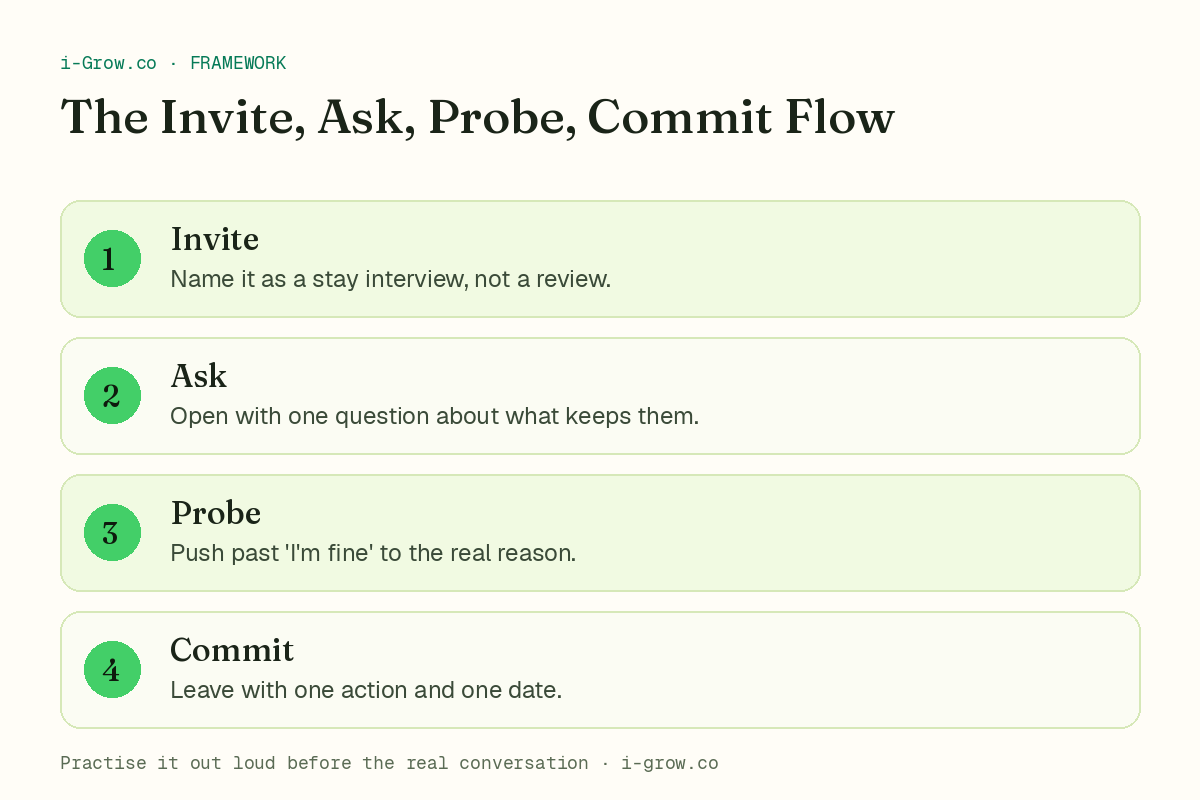
Invite sets the frame before the meeting even starts, so nobody shows up bracing for bad news. Ask opens with one low-stakes question to get past the first, safe answer. Probe is where the real information lives — most people's first answer isn't their real answer. Commit is the step people skip, and it's the one that makes the whole exercise worth repeating next quarter.
How to Invite Someone to a Stay Interview
The invite matters more than it looks. Vague wording ("got 20 minutes to chat?") reads as ominous. Specific wording reads as routine.
"Hey — I want to grab 20 minutes next week, not for a review, just to check in on how things are going for you here and what I could be doing better as your manager. Does Thursday at 2 work?"
Name the length. Name that it isn't a review. Give them a real choice of time. That's the whole invite.
The 5–7 Core Questions to Ask
Ask these in your own words, in roughly this order — open, then specific, then forward-looking.
- "What's keeping you here right now?"
- "What's the first thing you'd change about your job if you could?"
- "Has there been a moment lately when you wondered about leaving? What set it off?"
- "What would make next year here better than this year?"
- "Is there a skill or project you want that you're not getting?"
- "How do you want to be recognized when you do good work?"
- "If you got a call from a recruiter tomorrow, what would make you take the meeting?"
You don't need all seven in one sitting. Four or five, asked slowly, beats seven asked fast.
Opening and Closing Scripts
The words you use to start and end the conversation set whether the answers are honest or rehearsed.
Opening:
"Thanks for making time. This isn't a review — I just want to understand what's working for you here and what isn't, so I can actually do something about it. Nothing you say here changes your standing with me. Where do you want to start?"
Closing:
"This was genuinely useful — thank you for being straight with me. Here's what I heard: [repeat the one or two things that mattered]. Here's what I'm going to do about it, and by when: [action, date]. I'll follow up with you on [date] either way, even if the answer is 'still working on it.'"
The close is where most managers go silent out of discomfort. Silence here is what turns a stay interview into a complaint box nobody checks.
When They Push Back or Go Vague
Not every answer is usable on the first pass. Here's how to move past the safe version to the real one.
| They say | You say |
|---|---|
| "I don't know." | "Take your time — if it helps, think about the last really good week here versus the last really bad one. What was different?" |
| "Everything's fine." | "Glad to hear it. If you had to pick one thing to tweak anyway, even something small, what would it be?" |
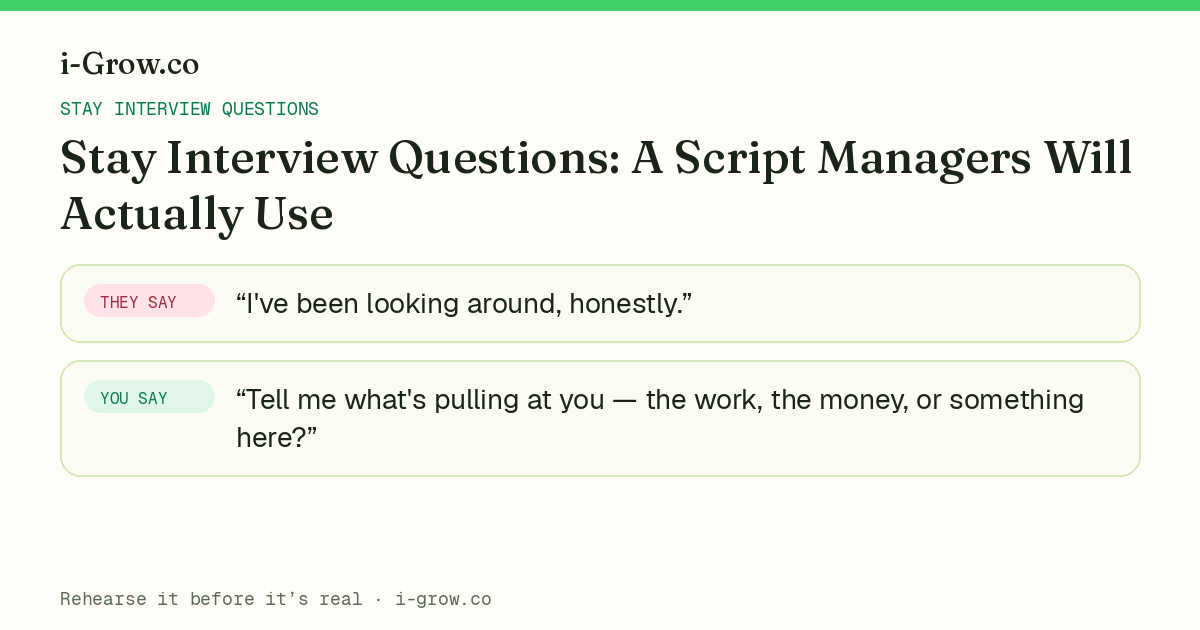
| "I've been looking around." | "Thanks for telling me straight — I'd rather know. What's driving the search: the work, the money, or something about the team?" |
| "Can this stay between us?" | "Mostly, yes. If something you say requires me to act — like a safety or policy issue — I'll tell you before I do anything with it. Otherwise this is just between us." |
| "So am I getting a raise?" | "This conversation isn't where that gets decided, but I'll flag what you told me through the right channel and come back to you by [date] with where things stand." |
The "I've been looking around" answer is the one most managers freeze on. Don't react, don't talk them out of it in the moment, and don't pretend you didn't hear it — ask the follow-up and let the real reason surface.
Practice this skill
Rehearse the question before you ask it
Practice opening a stay interview and handling a flat 'everything's fine' answer with an AI counterpart that pushes back like a real employee would.
Rolling this out to a team of new managers? Book a 30-minute pilot fit call →
What to Do With the Answers — One Action, One Date
A stay interview that produces notes and no follow-through is worse than skipping it, because it teaches the employee that honesty here doesn't change anything.
After every conversation, write down exactly two things: the one action you're taking, and the date you'll report back — to that person, specifically, not in a general team update. "I'll look into flexible hours and get back to you by the 15th" is a commitment. "I'll see what I can do" is not.
If the honest answer is that you can't fix the thing they raised — comp band, team structure, a promotion timeline — say that plainly instead of overpromising. A clear "I can't change X, but here's what I can do" holds more trust than a vague maybe that quietly dies.
Rolling Stay Interviews Out Across a Team
One manager running good stay interviews protects one team. The exposure most HR and L&D leaders are actually managing is dozens of managers running them inconsistently — or not at all, because nobody's ever told them what to say when someone answers "I don't know" or "I've been looking around."
That's a training gap, not a template gap. Handing managers a question list doesn't prepare them for the moment the answer gets uncomfortable — see the real cost of managers who avoid hard conversations for what that avoidance costs in attrition you don't see coming until the resignation letter.
If you're deciding whether to build this into your manager training this quarter, book a 30-minute pilot fit call — i-Grow's team pilot runs 25 seats for 90 days at $1,500, live in under a week, with managers rehearsing stay-interview openings, probes, and exactly these pushback lines in ten-minute reps. You see aggregate skill movement across the team; individual transcripts stay private to the manager who practiced.
Rehearse It Before You Run It
Reading a script and saying it out loud under pressure are different skills. The gap usually shows up at the exact moment someone says "I've been looking around" and the manager either freezes or overreacts.
Run the opening and the "looking around" probe through the difficult conversation planner to structure what you want to say before the meeting. Then start free, no credit card and rehearse the actual conversation with an AI counterpart that pushes back, bargains, or goes quiet the way a real employee might — so the first time you hear "I've been looking around" out loud isn't in the real meeting.
Limitation: no script survives contact with every personality. Someone who's genuinely checked out may give you one-word answers no probe will open up — in that case, the stay interview itself is your data point, not a failure of the questions.
Practice this skill
Give every manager this script before their next one
Roll stay interviews out to your team with a pilot that trains managers on the questions and the pushback. Free to start: 3 practice conversations, no credit card · Private by default.
Rolling this out to a team of new managers? Book a 30-minute pilot fit call →
Frequently asked questions
What is a stay interview?
A stay interview is a short, scheduled conversation where a manager asks a current employee why they stay, what frustrates them, and what would make them leave. Unlike an exit interview, it happens while the person is still engaged enough to act on, not after they've already decided to go.
How is a stay interview different from an exit interview?
An exit interview happens after someone has already resigned, when nothing you learn can change their mind. A stay interview happens while they're still deciding, so the answers are actionable. It's also different from a performance review — it's about the job fitting them, not the other way around.
How often should managers run stay interviews?
Once or twice a year for most employees, and sooner for anyone newly promoted, newly hired, or showing signs of disengagement. Treat it as a standing practice, not a one-time fire drill triggered by a resignation scare — the value comes from catching problems before someone updates their resume.
Should HR or the direct manager run the stay interview?
The direct manager should run it, because they're the one who can actually change the day-to-day conditions being discussed. HR's job is to design the questions, train managers to ask them well, and track themes across teams — not to sit in on individual conversations.
What if an employee says they've been looking around?
Thank them for the honesty instead of reacting, then ask what's driving the search — compensation, growth, the work itself, or something about the team. That answer tells you whether you have a real shot at keeping them or whether you're documenting a loss you can learn from.
What if the employee asks for a raise during the conversation?
Say plainly that this conversation isn't where compensation gets decided, but that you'll flag what you heard through the right channel and follow up by a specific date. Promising a number on the spot undermines both the comp process and your credibility if it doesn't come through.
How long should a stay interview take?
Plan for 20 to 30 minutes. Long enough to get past the first, safe answer to something real, short enough that it doesn't feel like a formal review. If you're consistently running past 30 minutes, you're probably trying to solve problems live instead of scheduling a follow-up.
What do you do with the answers afterward?
Pick one thing you can act on and attach a date to it, even if the action is small. A stay interview that ends in a list of complaints and no follow-through is worse than not asking at all, because it teaches people that being honest with you doesn't change anything.
Sources
The exit interview tells you why they left. The stay interview is your only shot at asking while it still matters.