
Skip-Level Meeting Questions: Agenda, Script, What to Say
A 30-minute agenda, a question bank in plain language, and the exact lines to use when a skip-level goes somewhere you didn't plan for.
A skip-level meeting is a direct conversation between a leader and an employee who reports to someone else on their team — not a performance review, not a complaint line about that employee's manager, just a chance to hear what's actually happening two levels down. Done well, it surfaces problems early. Done badly, it reads as surveillance.
What Is a Skip-Level Meeting (And What It Isn't)?
A skip-level meeting is a structured one-on-one between you and a person who doesn't report to you directly — usually someone on a manager's team, one level below where you normally meet. The Management Center's skip-level toolkit defines it as a structured one-on-one between a manager and a staff person they don't manage directly. In practice, it's your chance to hear from people you'd otherwise only know through their manager's account.
It isn't a performance review — you're not evaluating this person's output, and nothing from the conversation should land in their file. It isn't a disciplinary hearing for their manager, even if the conversation turns there. And it isn't a one-time "state of the team" address where you talk and they nod. The entire value of a skip-level comes from you listening more than you talk.
What it is: a rotation. You meet with people across a team or org, on some cadence, specifically so that no single meeting looks like an investigation. That rotation is also your best defense against the nervousness this section is about to cover.
Why Do Employees Get Nervous About Skip-Levels?
Almost nobody gets invited to a skip-level and thinks "great, a casual chat." The instinct is to assume one of three things: something's wrong with my performance, something's wrong with my manager and I'm about to be asked to inform on them, or something's wrong with the business and this is how I find out.
The Management Center's advice holds up well here: tell the manager in advance that you're meeting their reports, and tell the employee why you're meeting them before you're in the room, not after. Silence about the "why" is what turns a routine rotation into thirty minutes of someone trying to read your face.
Two specific worries dominate, and they're the two you need a script for: "is this about layoffs?" and "do they want me to say something bad about my manager?" We'll script both below. Everything else — nerves about saying the wrong thing, about being too candid, about wasting your time — mostly dissolves once you open with a clear, honest frame.
What Should Be on the Agenda for a Skip-Level Meeting?
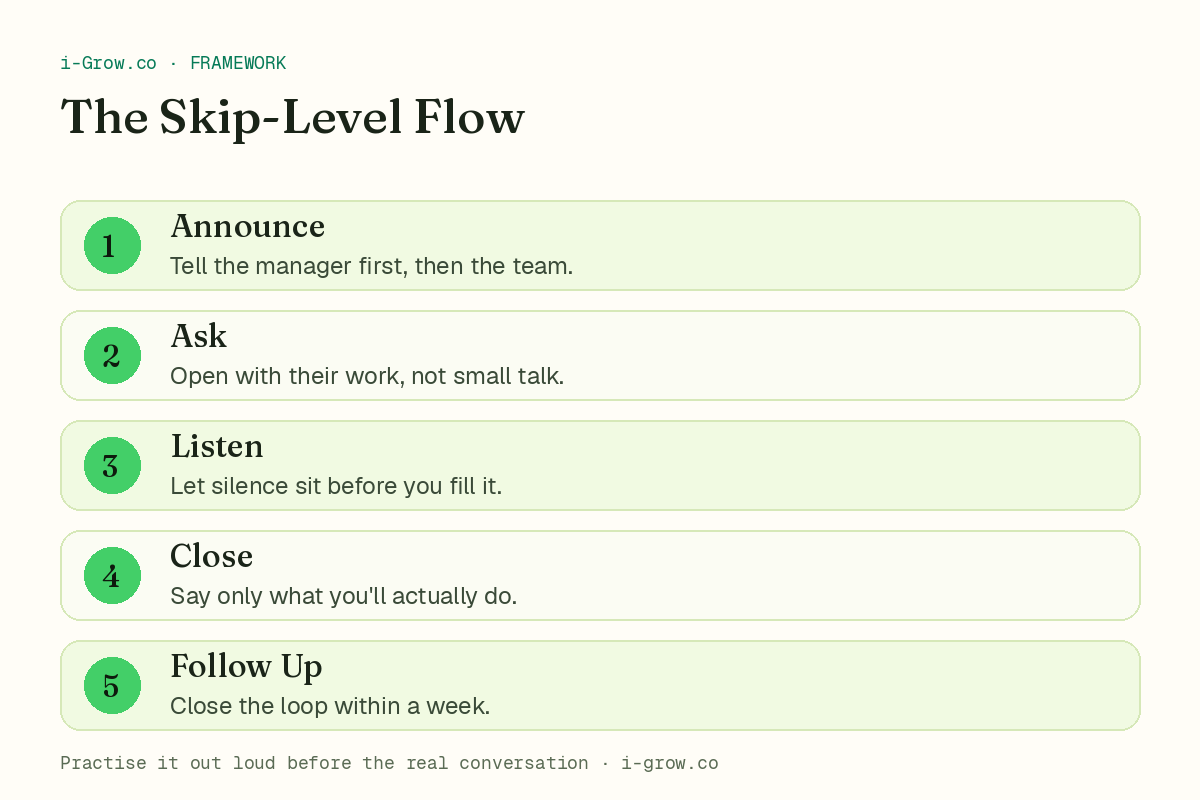
Thirty minutes is enough if you don't try to cover everything. Here's a sample agenda that keeps the structure tight and leaves room for the employee to actually talk:
- 0–3 minutes — Open and set the frame. Say why you're meeting them (the rotation, not a flag on their name) and how you'll use what they say.
- 3–10 minutes — Their work. What they're doing, what's going well, what's slowing them down. This is the warm-up; it's also often where the real signal shows up first.
- 10–20 minutes — Their manager and the team. How decisions get made, how feedback flows, what the team's rhythm feels like day to day.
- 20–27 minutes — The organization and their career. What they'd change if they could, where they see themselves in a year, what they don't understand about decisions made above their manager.
- 27–30 minutes — Close. Thank them, tell them what happens to what they said, and tell them when you'll follow up.
If you only have fifteen minutes, keep the open and the close and compress the middle into two or three strong questions rather than rushing through all four blocks.
What Questions Should You Ask in a Skip-Level Meeting?
Open-ended beats yes/no every time, and "can you give me an example" turns a vague answer into a useful one. Here's a question bank organized by what you're actually trying to learn.
Rapport and context - What does a typical week look like for you right now? - What's the last thing that took longer than it should have? - What would you want me to know about your role that isn't obvious from the outside?
The work itself - What's getting in the way of doing your best work? - Where do you feel like you're guessing instead of knowing? - If you could change one process tomorrow, what would it be? - What's something you're proud of that hasn't gotten much notice?
Their manager - How do you find out about decisions that affect your work? - When you've raised a concern, what happened next? - What does your manager do that you'd want every manager to do? - Is there anything your manager does that makes your job harder than it needs to be?
The organization - What's a decision from above that you didn't understand the reasoning for? - What do you wish leadership understood about this team? - Where do you see friction between this team and others?
Career and growth - What skill do you want to be using more a year from now? - What would make you consider leaving? - Is there anything you want to be doing that you're not currently getting a chance to do?
You don't need all twenty in one sitting. Pick five or six that fit the person and the time you have, and let their answers decide where you spend the rest of the meeting. For a structured version you can adapt before your next one, the difficult conversation planner walks through building your own line-by-line plan.
Practice this skill
Your managers are the ones in the room, not you
Skip-levels tell you where a manager is avoiding the hard conversation. The 90-day pilot gives that manager reps on the exact conversation, before the next skip-level surfaces it again.
Rolling this out to a team of managers? See the 90-day pilot (25 seats, $1,500) → or book a 30-minute call with the founders →
What Do You Say When an Employee Asks "Is This About Layoffs?"
This is the question you need an answer to before you book the meeting, not while you're sitting across from someone who just asked it. There are two real scenarios, and they need two different answers — never one answer regardless of which is true.
If it genuinely isn't connected to any staffing decision, say that plainly:
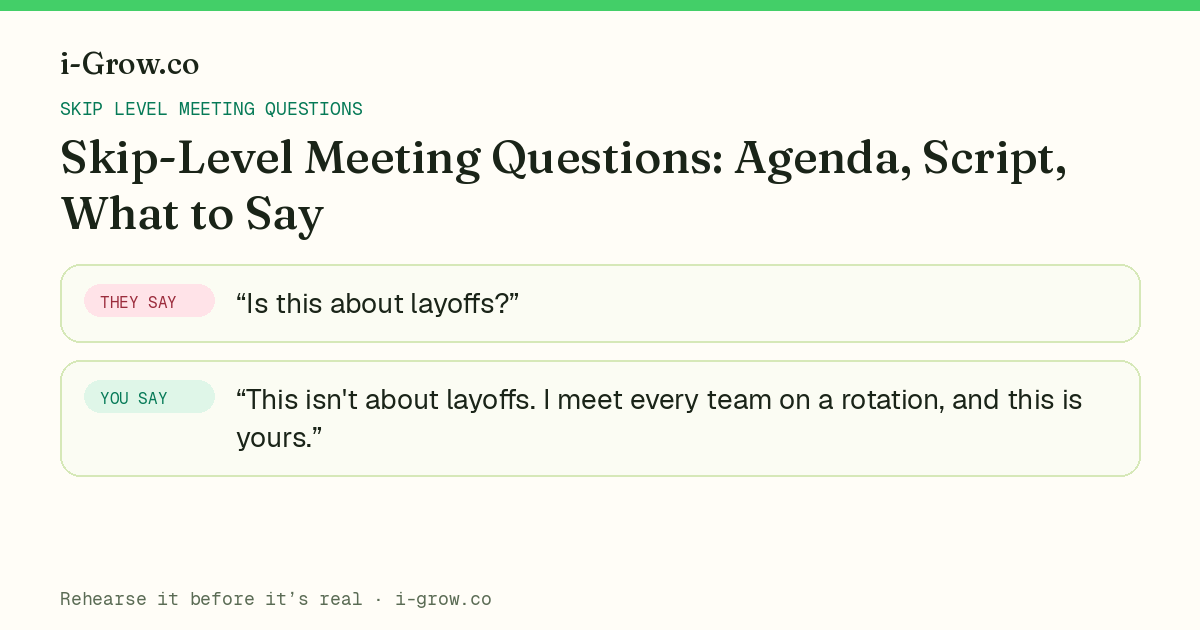
"This isn't about layoffs. I meet every team on a rotation, and this is yours. There's no decision tied to this conversation — I just want to hear how things are going from you directly."
If a reorg or reduction actually is planned and you're not yet able to disclose it, do not hold the skip-level as if it's routine, and do not lie. A flat denial that turns out to be false will cost you more trust than the delay would have. The better move is to postpone the meeting, or loop in HR first on how — and whether — to proceed given the timing. "Routine" skip-levels scheduled the week before a layoff announcement tend to be remembered, and not kindly.
What Do You Say When an Employee Criticizes Their Manager?
This is the moment most leaders aren't ready for, because it can arrive in the middle of an otherwise calm conversation. The sequence that holds up: get specifics, don't fix it on the spot, be honest about what you can and can't keep confidential, and route anything serious to HR.
"Can you give me a specific example, so I understand what you mean?"
Vague complaints ("my manager plays favorites," "the team feels tense") are hard to act on and easy to misremember later. A specific example — a decision, a meeting, a comment — is something you can actually follow up on.
"I'm not going to fix this in this meeting. I am going to take it seriously and come back to you by Friday."
Don't promise a resolution you can't deliver on the spot, and don't promise one at all if you're not sure what the fix looks like yet. A deadline for a follow-up is a promise you can keep.
If what you're hearing sounds like a manager who avoids feedback entirely rather than a one-off complaint, that's worth naming to yourself as a pattern, not a grievance — see underperformance feedback for how to think about a manager who's underperforming at the manager-specific parts of the job.
If it rises to harassment, discrimination, or anything that could be retaliation for a prior complaint, stop trying to handle it yourself:
"I'm glad you told me. Because of what this is, I need to bring HR in, and I'll tell you what happens next."
The U.S. EEOC is explicit that retaliating against someone for raising a discrimination or harassment concern is its own violation, separate from the underlying issue — all the more reason to route it correctly and not sit on it. This isn't legal advice, and if you're not sure whether something clears that bar, ask HR or employment counsel before you decide on your own.
What Can You Keep Confidential — And What Can't You?
Be honest about the limits before someone tells you something you can't fully protect.
"I can't promise everything stays anonymous, but I will be careful how I use it, and I won't quote you to your manager."
That's an honest, keepable promise. What it rules out: promising full anonymity when only one or two people could plausibly have said something, and promising confidentiality at all for harassment, discrimination, safety issues, or anything HR needs to know about regardless of what the employee wants. Say that distinction out loud if it comes up — it's better heard before someone tells you something than after.
What Is the 40/20/40 Rule for Meetings?
There's no single agreed-upon definition here — it isn't a formal standard, more an informal rule of thumb some teams use to describe where meeting effort should actually go: roughly 40% in preparation, 20% in the meeting itself, and 40% in follow-up.
Applied to a skip-level, that split looks like this: 40% is deciding your agenda, reviewing what you know about this person and team, and thinking through how you'd handle the "is this about layoffs" question if it came up. 20% is the 30 minutes in the room. The last 40% is what you actually do with what you heard — the note you send, the follow-up you promised by Friday, the pattern you flag to yourself across five skip-levels on the same team. Skip-levels that feel like theater are usually ones where that last 40% never happens.
How Do You Close a Skip-Level Without Over-Committing?
Thank them specifically for something they said, not generically for their time. Tell them what happens to the conversation — who else, if anyone, hears about it, and in what form. Commit to one concrete follow-up action with a date attached, not a vague "I'll look into it."
Then actually follow up within a week. The single fastest way to make the next skip-level harder is to let this one go quiet after you promised it wouldn't.
They Say | You Say
| They say | You say |
|---|---|
| "Won't employees assume something bad if I suddenly book a skip-level?" | Tell them why up front, every time, and keep it on a visible rotation — not a one-off. A skip-level that only ever happens before bad news earns that reputation fast. |
| "I don't want to undermine my manager." | You're not there to override them — you're there to hear what doesn't reach you otherwise. Don't make commitments on their behalf, and don't relay specifics back in a way that reads as going around them. |
| "They'll just tell me everything is fine." | "Fine" is what you get from yes/no questions. "What's the last thing that took longer than it should have?" gets a real answer. |
| "These always feel awkward and scripted." | They feel scripted because most leaders improvise the two hard moments. Script "is this about layoffs" and the manager-complaint response in advance, and the rest of the conversation can stay loose. |
What Questions Can an Employee Ask Their Skip-Level?
Skip-levels work both directions. If you're the one being asked to a skip-level, these are worth having ready:
- What would you want to know about this team that you're not currently hearing?
- How does feedback from conversations like this actually get used?
- What's something you wish more people at my level understood about how decisions get made here?
- Is there anything you're seeing across teams that you think my manager should know?
- What does good look like for someone in my role, from where you sit?
If you're a manager preparing your own team for the conversation their boss's boss is about to have, first-time manager training covers the broader set of conversations new managers tend to dodge — skip-level visibility is usually what surfaces them.
When the Skip-Level Surfaces a Bigger Problem
Sometimes what comes out of a skip-level isn't a one-off complaint — it's a pattern. A manager who won't give direct feedback, a team that's checked out, a reorg that's going to land badly if it's handled the way the last one was. Reading about how to handle a layoff conversation with dignity after the fact is useful — see layoff with dignity — but the harder problem is usually earlier: a manager who's never actually practiced the conversation they're avoiding.
That's the real gap skip-levels expose, and it's not one a slide deck fixes.
Twenty-five manager seats, 90 days, a Learning-Needs Session with Pallavi Bhatt up front to map exactly which conversations your managers are avoiding — the pilot gives them reps on that conversation before the next skip-level surfaces it again. See the 90-day pilot or book a 30-minute call to talk through fit.
If you run skip-levels yourself and want to pressure-test your own handling of the layoffs question or a manager complaint before your next one, you can rehearse it yourself — start free, no credit card. Or run the leadership diagnostic first to see where your own gaps are before you go looking for your managers'.
If what surfaces instead is tension between someone and a former peer they now manage, managing former peers is the more specific read.
Practice this skill
Give the next skip-level a different answer
Twenty-five seats, 90 days, a Learning-Needs Session before the first rep — see what a pilot looks like. Free to start: 3 practice conversations, no credit card · Private by default.
Rolling this out to a team of managers? See the 90-day pilot (25 seats, $1,500) → or book a 30-minute call with the founders →
Frequently asked questions
What should be on the agenda for a skip-level meeting?
A short open that names why you're meeting, a block on their work and what's in their way, questions about how their manager runs the team, a window for organizational questions, and a close where you say what happens next. Thirty minutes is enough if you keep each block tight and leave room for silence.
What is the 40/20/40 rule for meetings?
It isn't a formal standard — it's an informal rule of thumb some teams use to split effort: roughly 40% of the work in preparation, 20% in the meeting itself, and 40% in follow-up. For a skip-level, that means your agenda and your notes before the meeting, and what you actually do with what you heard after, matter more than the 30 minutes in the room.
What are good questions to ask in a meeting?
Good meeting questions are specific, open-ended, and ask for an example rather than an opinion. In a skip-level, that means trading 'how's it going?' for 'what's the last thing that slowed you down?' — a question that produces a real answer instead of a reflexive 'fine.'
What are 6 powerful questions to ask in a performance review?
Performance reviews ask about goals, growth, and specific feedback tied to one person's output over a period — things like what went well, where they fell short, and what support they need next. Skip-level questions are different: they're not evaluating the employee at all. They're listening for how the team and the manager are doing, through that employee's eyes.
What's the difference between a skip-level and a regular one-on-one?
A one-on-one is between an employee and their direct manager, usually about their own goals and work. A skip-level is between an employee and their manager's manager, and it isn't about evaluating the employee — it's a listening session on team health, the manager's effectiveness, and anything blocking the work that might not reach you otherwise.
How often should you hold skip-level meetings?
There's no universal rule. The Management Center suggests aiming for about twice a year per person, or quarterly if you only have a handful of people to meet. More frequent than that and they can start to feel like monitoring; less frequent and you lose the thread on what's changing.
What do you say if an employee asks whether a skip-level is about layoffs?
Tell them the truth. If it isn't connected to any staffing decision you know of, say so plainly and explain the rotation. If a reorg or layoff is actually planned and you can't disclose it yet, don't lie and don't hold the meeting as if it's routine — postpone it or loop in HR on how to handle the timing.
Can what an employee says in a skip-level stay confidential?
Partially. You can promise to be careful about how you use what they tell you and not quote them directly to their manager. You can't promise full anonymity, especially if only one or two people could have said something, and you can't promise confidentiality at all for harassment, discrimination, or safety issues — those go to HR regardless of what the employee asks.
Sources
A skip-level only works if you're willing to hear something you'll have to act on.